
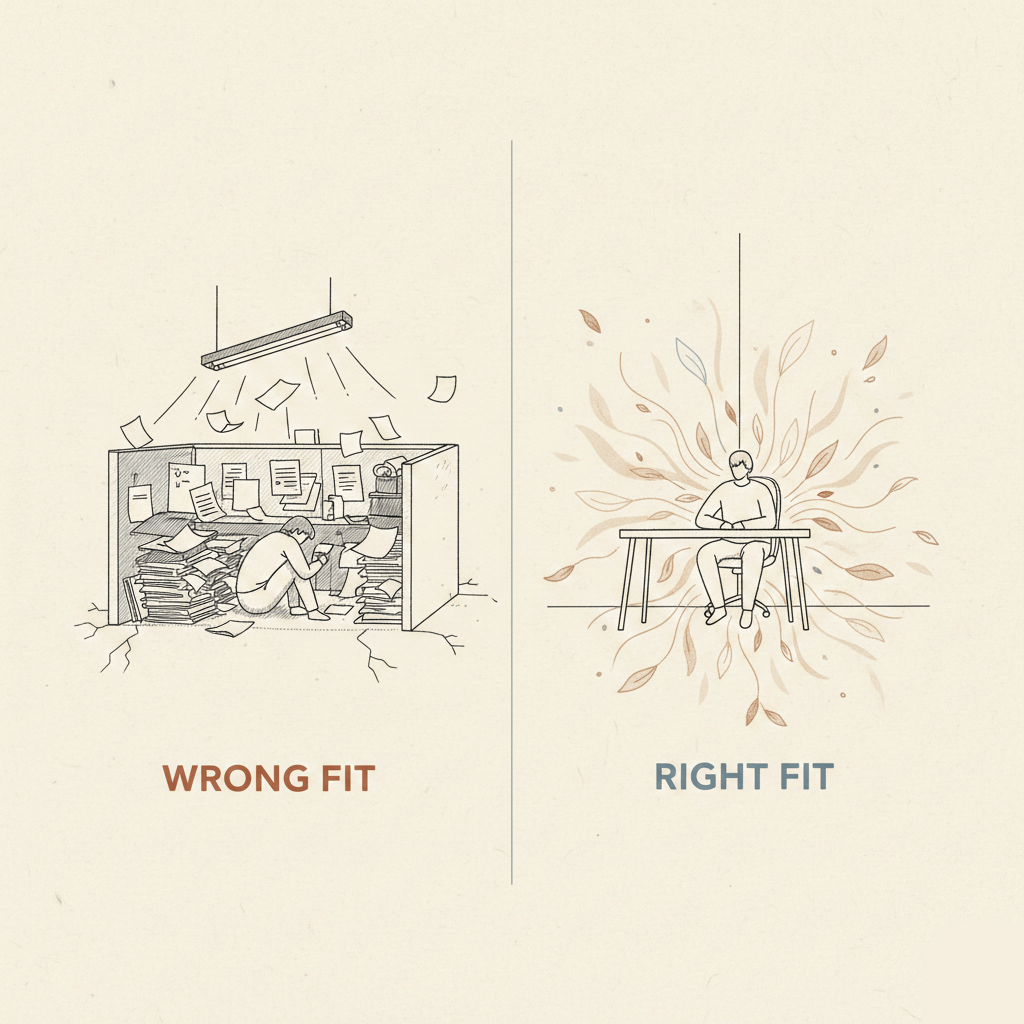
Are you sure you’re experiencing burnout at work or is it something else?
Being skilled doesn’t mean you’re in the right place. Sometimes the work fits your résumé but not your values, and that mismatch can wear you down in ways nobody else sees.
Over time, this misalignment can lead to something deeper and harder to name.
You started your business because you cared. About waste, about wellness, about people being treated fairly in supply chains.
Over time, a harder truth set in. Even when you’re trying to “make the world better,” you can’t do everything. And more importantly, you shouldn’t.
So when you ask, what version of making the world better actually fits the way I’m built? a few threads come up.
- Are you energized by visibility, or do you thrive behind the scenes?
You might admire activists on the frontlines or magnetic thought leaders. But if you’re more of a quiet stabilizer, forcing yourself into those roles will drain you and dilute your impact over time. - Do you create clarity, or do you create momentum?
Some people map complexity and give it shape. Others galvanize teams, get products shipped, rally customers. Both matter. But one might serve best as a system designer or advisor, the other, as a campaigner or lead collaborator. - Where does effort feel expansive vs. contracting?
This one’s subtle, but critical. Work can be tiring and still feel right when it’s aligned. But if every “ethical” decision starts to feel like a guilt-ridden obligation, you may be trying to live someone else’s model of good.
So now the questions become:
- What if your best contribution isn’t loud, but consistent?
- What if you change the world not by scaling endlessly, but by modeling a regenerative way of working with a small, loyal team?
- What if your digital presence isn’t about shouting into the void, but about being easy to find by the people already looking for what you offer?
People often knowingly misfit themselves.
Because survival demands it.
Because status seems to.
And while that can work for a while there’s always a cost. Usually paid later, in burnout, cynicism, or quiet despair.
Economic Pressure and Burnout at Work, Front and Center
The economy weighs heavy. People optimize for stability, not self-actualization. When someone finally lands a role with decent pay, prestige, or security, it’s easy to rationalize misalignment:
I should be grateful.
Maybe I’m just not trying hard enough.
This is what success looks like.
The sad thing? Once you contort yourself to fit a role you think you’re supposed to want, your original gifts can go dormant.
From the outside that loss is almost invisible.
But you feel it.
Cultural Narratives Around Value
Certain roles are glamorized. Founder, thought leader, CMO, visionary. Others, like steady operations lead, ethical supply chain architect, emotionally intelligent team builder, rarely make headlines, even though they’re often the ones preventing burnout at work by holding things together.
Many people reach for roles that look like impact or prestige, instead of reflecting on what kind of contribution truly aligns with their values and prevents the emotional exhaustion that comes with career misalignment.
Confusing Competence with Calling
Just because you’re good at something doesn’t mean it nourishes you. But competence gets rewarded (or so they say), especially in capitalist systems which makes people stay stuck doing what they can do, not what they should do.
Coping becomes identity and that’s when it gets dangerous.
Lack of Reflective Space
Very few are given the time, safety, or tools to ask themselves: what kind of work allows me to think, create, and relate at my best? Without that pause, the path of least resistance wins.
Misalignment might begin as a compromise, but over time it calcifies. And when crisis comes, as it always does in business, the misfit is exposed. If you don’t believe in what you’re doing, and the money starts to wobble, the emotional cost becomes unbearable.
A more honest and sustainable way to think about work might not begin with what you can do, or even what’s available. It starts with alignment. And cost.
Energetic Alignment
Does this work make me feel more alive or more hollow? (Do I want to get better at it, even on hard days?)
This is about your temperament, your energy patterns, your core fascinations.
You don’t have to love every task. But there needs to be a current running through the work that feels like you.
Structural Sustainability
Can I live with the rhythms this work imposes (schedule, intensity, environment)
This is about your nervous system. Your relationships. The kind of life you’re actually trying to build, not just the role you’re filling. Other things matter, you know.
Value Congruence
Do I respect how this work contributes to the world?
When this thread gets lost, even high pay can’t buffer the slow corrosion of doing something you don’t believe in.
Compromise vs. Self-Betrayal: Spotting Burnout at Work Early
Tolerable Compromise (Strategic, Contained)
- a temporary trade-off with a clear endgame.
“I’ll do this for 12 months while I build my own studio.” - a not-quite-perfect role that supports a long-term aligned goal.
- doing “meh” work inside a deeply values-aligned org.
Not ideal, but I’m still me in this, you may be thinking.
Intolerable Compromise (Identity-Eroding)
- chronic mismatch with no exit plan.
- doing work that violates your values (selling what you wouldn’t buy, enabling harm).
- staying “for the money” while your mental health tanks.
You’re thinking, I don’t recognize who I’m becoming. And you’re thinking it often. This kind of disconnect is a common early warning sign of burnout at work.
It comes down to honest self-inventory. Not the kind you perform for others, but the kind that demands brutal honesty, even in private. There has to be a quiet inner yes, even if the role isn’t perfect.
One small question I often offer to peers navigating a shift: If I succeed at this, will I become someone I like more or less?
Values? In this Economy?
Now let’s talk about that old line: “A good salesperson should be able to sell anything.”
Cringe? Same.
It’s often framed as a badge of mastery. A neutral truth. But really, it’s a value-smuggled statement because the unspoken assumption is:
- You should be able to detach from your values.
- You should perform belief on demand.
- You should trade clarity for conversion.
This thinking falls short in more than one ways.
It Treats Skill as Disconnected from Meaning
The idea suggests that persuasion is valuable no matter what’s being sold. That selling is about technique, not truth.
But for values-driven professionals, persuasion without belief quickly feels hollow. Manipulative. Sometimes even shameful. You get good at getting yeses, but bad at sleeping at night.
It Ignores the Emotional Cost of Cognitive Dissonance
If you wouldn’t buy it or believe in it, but your job is to convince others, you feel it. Even when you’re “performing,” there’s internal friction.
I’m using my gifts to push something I wouldn’t accept myself.
Over time, that friction builds into burnout, eroded self-trust, emotional detachment. The only way to survive is to split your integrity from your professional identity.
That’s not sustainable.
It Creates a Culture of Surface Over Substance
When companies praise “killer closers” without caring what they’re closing, they normalize disengagement from consequences. That may drive short-term numbers but it erodes trust, morale, and brand credibility.
People notice.
Even great salespeople want to feel proud, not just praised. And underneath it all is a kind of insecure, command-and-control logic:
If we make belief irrelevant, everyone becomes interchangeable. If you care too much, you’re weak.
Ironically, the best salespeople I’ve known are deep believers. They don’t just sell well because they’re skilled, they sell well because they’re aligned.
That alignment builds conviction, and conviction builds trust. Which, funnily enough, sells better. It’s disrespectful to these professionals to say we’re all salespeople.
The Misfit
The trap of doing misfitting work, work that can lead to burnout, can be escaped, even as a younger professional.
Doing so requires space, whether internal or external, for critical thinking, inner permission, and courage. That space is rare, especially early in your career, when power dynamics and unspoken rules make questioning the status quo feel like career destruction.
Let’s pull it apart from a few angles:
The Young Professional’s Vulnerability
Early-career professionals are often:
- hungry to prove themselves
- low on leverage
- still learning to trust their instincts
So when a boss says, “Good salespeople sell anything,” or a PM shrugs, “Just push the feature, ethics isn’t your job,” the social script is clear: if you resist, you’re the problem.
This creates a kind of manufactured insecurity dressed up as professional maturity. The truth is many young professionals feel the misalignment. They just haven’t been told that feeling is valid.
Systems That Reinforce the Trap
Especially in startup culture, roles are often tactically defined but ethically underdefined.
- the SDR is told to hit quota, forget vetting the offer.
- the growth lead is told to drive signups, not ensure the product delivers.
- ops is told to optimize, not to question the moral cost of efficiency.
And in these environments, obedience gets rewarded more than discernment. Pushback gets labeled as being “difficult,” “not a team player,” or “too idealistic.”
None of that makes YOU wrong. It just means the incentives weren’t designed with integrity in mind.
The Silent Discipline Everyone Practices Anyway
Whether or not it’s called “ethics,” everyone is already making ethical decisions daily:
- Do I stretch the truth on this sales call?
- Do I market to someone I know probably can’t afford it?
- Do I implement this UX pattern even though it’s a little deceptive?
Just because something is legal, scalable, or rewarded doesn’t mean it’s right.
So Can You Escape the Trap Early?
Yes. But you need a few things:
A framework for ethical discernment.
Not all discomfort means something’s wrong. But a clear lens (harm, honesty, dignity) helps you sort gut signals from grounded red flags.
Mentors or peers who validate questioning.
Sometimes all it takes is one person saying, “You’re not crazy for wondering if this is messed up.” That changes everything.
A strong enough identity that isn’t built solely on external validation.
This takes time. But self-authorship begins the moment you say I want to be the kind of professional who can look myself in the mirror.
You don’t have to wait for mid-career clarity to realize that dissent can be ethical and performance doesn’t have to cost you your principles.
When Something Feels Off, Try These Spot-Checks:
Am I doing good in a way that feels true or just looks good?
Do I respect this system, or am I just performing inside it to survive burnout while at work?
If this succeeded wildly, would I be proud or just relieved?
Think of these as a compass, something to return to again and again as your work, life, and the world shift around you.
It’s powerful to want to do real good. Just make sure you’re doing it with your eyes wide open.