
AI Is Exposing the Illusion Economy
The great unmasking of the mediocre has begun, and it is powered by a machine.
For years, the internet was a stage where charisma could outpace competence. A slick homepage and a persuasive sales sequence were enough to create the illusion of mastery. A business owner who barely understood their own service could rent the appearance of expertise. They hired a copywriter with rhythm and nerve, and the copywriter did what copywriters do: compress confusion into confidence. The result was a funnel that worked. Clients signed and then contracts flowed. The gap between rhetoric and reality only revealed itself months later (before anyone had to evaluate AI output and fluent language alone could still pass for understanding), when the service faltered and the refunds began.
Artificial intelligence has short-circuited that arrangement.

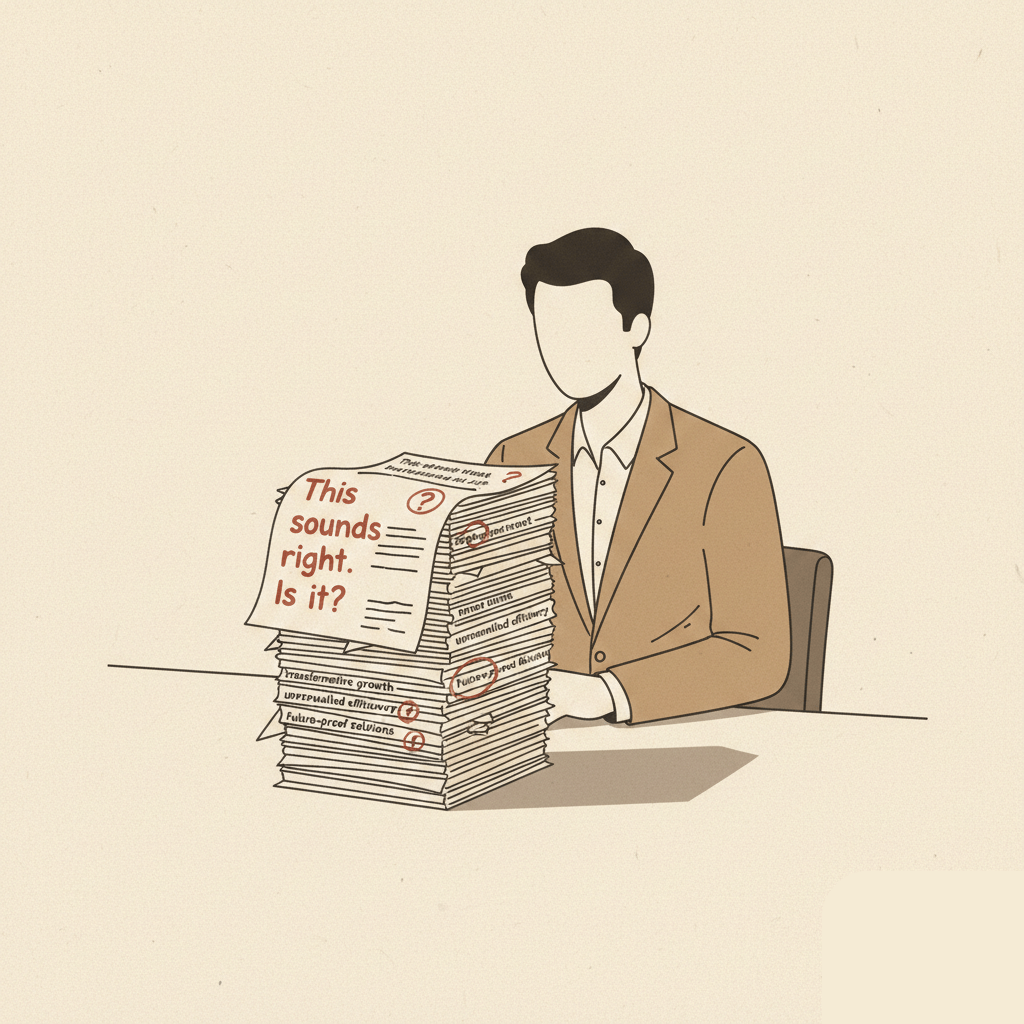
The new tragedy is not that business owners are using AI to write their websites and emails, but that so many of them are impressed by what it produces. They read the bland, overextended paragraphs and think “this sounds professional”, without the ability to evaluate AI output against real expertise. They publish it as-is. And in doing so, they reveal something far more consequential than bad prose. They reveal that they do not know what good looks like in their own field.
This is the central irony of AI; it amplifies competence, but it exposes incompetence. If you are already good at a task, you can use AI as a lever. If you are not, you will mistake average output for excellence. And in that mistake, you announce your limitations to the world.
Before the current AI boom, unqualified operators could survive on borrowed clarity. The digital economy made that possible. A marketing-savvy founder could build a coaching practice without having coached anyone. All they needed was a compelling narrative. And narratives are easy to outsource.
Talented copywriters became the invisible infrastructure of this illusion economy. They absorbed half-formed ideas, extracted a coherent angle, and wrapped it in urgency, effectively evaluating structural weaknesses that AI cannot detect on its own.
They made thin services sound robust. They constructed value propositions from fog. They were often underpaid for the intellectual heavy lifting they performed. Their craft both polished language and covered structural weaknesses in the businesses themselves.
Now all that is gone.

When a founder pastes their rough thinking into an AI system and publishes the output with minimal revision, they are not outsourcing to a sharp human who will challenge their assumptions. They are outsourcing to a pattern engine that mirrors their input. If the thinking is shallow, the output will be shallow in fluent sentences. And if the founder cannot tell that it is shallow, that is the tell.
Consider translation. If you do not know Spanish, you cannot judge whether a Spanish paragraph is elegant or clumsy. You cannot hear when a phrase lands like a brick. You cannot sense when the timing is off, when the register is wrong, when the cultural reference misfires. An AI can generate Spanish words in plausible order. It cannot give you the internal alarm that a native speaker has when something sounds off. Only someone who knows the language can perform that verification pass.

The same logic applies everywhere. AI can generate a legal-looking contract. It cannot tell you whether the indemnification clause is dangerously weak. AI can produce a sales page with headings and bullets. It cannot detect when the promise outstrips the actual capacity of the business. The verification step requires domain knowledge which cannot be faked by fluency, because it is the only thing that allows you to evaluate AI output without deceiving yourself.

What we are witnessing is a filtering event. Pre-AI, the barrier to entry in many knowledge industries was persuasion. The cost of producing persuasive text was high enough that it created a small advantage. You had to hire someone good. That cost filtered out some unserious operators and allowed others to pass as serious because they could afford the performance.
AI has collapsed that cost to near zero. Everyone can generate paragraphs. The rhetorical playing field is level. And when rhetoric becomes abundant, differentiation shifts back to substance.
The pattern is not new. Every technological expansion that lowers the cost of production floods the market with low-quality output. The railway boom of the 19th century produced both transformative infrastructure and catastrophic speculation. Investors poured money into rail lines that led nowhere. Companies built tracks without understanding demand. When the bubble burst, capital was destroyed, and so were reputations. What remained were the lines that actually connected cities and moved goods efficiently. Infrastructure survived. Hype did not.
AI-generated content is our minor bubble inside a larger transformation. The flood of generic templated websites and SEO-churn articles is the equivalent of rail lines to cornfields and sock-puppet startups with Super Bowl ads. It feels like expansion. It is mostly noise.
The cost structure explains everything. When producing a 1,000-word article required hours of skilled labor, you thought before publishing. When it requires thirty seconds and a prompt, restraint disappears. The marginal cost of mediocrity approaches zero, so the supply of mediocrity explodes.

In the short term, the unqualified founder benefits from speed. They can produce more content than ever. They can appear active, prolific, engaged. The platforms benefit from the volume. More posts mean more impressions, more ad inventory. AI companies benefit from subscription revenue.
The audience pays with time. Clients pay with confusion. Legitimate experts pay with signal dilution. The web becomes denser and harder to navigate. Trust erodes.
But the erosion of trust cuts both ways. When everything sounds polished, polish loses value. The eye learns to detect the familiar cadence of AI output with its tidy transitions and the generic optimism. Readers may not articulate why something feels thin, but they feel it. Engagement drops and the funnel leaks.
The unqualified operator, who once relied on a gifted human writer to sustain the illusion for months, now burns credibility in weeks. The bad copy signals that the person in charge cannot discriminate between strong and weak thinking.
Evaluating AI Output Is the New Line Between Experts and Amateurs
Expertise is, in part, the ability to evaluate quality within a domain. A skilled programmer spots a subtle bug in a block of code. A seasoned editor senses when an argument sags. This evaluative capacity is what allows them to use tools effectively. They can deploy AI and correct it. They know where the bodies are buried.
Those without that capacity are blindfolded. They see fluent sentences and assume correctness. They cannot perform the verification pass that AI requires.
And AI absolutely requires a verification pass.

Using AI for anything serious demands more attention, not less. Every claim must be measured against reality. Evaluating AI output is not a skim. Every line of code must be reviewed for edge cases. The tool accelerates draft generation; it does not eliminate responsibility. In fact, it multiplies the risk of subtle error because the output appears authoritative.
Who is best positioned to verify? The people who already understand the task deeply. The veteran developer can refactor AI-generated code and harden it. The seasoned marketer can reshape AI copy into something sharp and honest. In each case, AI is an assistant, not a substitute.
The unqualified founder cannot perform that oversight. They lack the internal benchmark. They cannot detect when a promise creates expectations the business cannot meet. They cannot hear when a sentence signals amateurism to insiders. They publish anyway.
The result is a market correction in slow motion. Potential clients, burned by shallow services and hollow content, become more skeptical. They demand proof. They look for track records and references. They test claims. The bar rises.
In that sense, AI is a blessing for buyers. It accelerates exposure. It shortens the distance between marketing and reality. The incompetent founder who once hid behind a copywriter’s craft now stands alone with a machine that reflects their own confusion back at them in articulate form.
For years, a certain type of operator treated communication as a costume. They did not respect the disciplines they entered. They respected the optics. They believed that if the website looked convincing and the emails felt persuasive, the rest would sort itself out. They externalized the burden of clarity onto writers and designers. They reaped the upside while others did the intellectual labor.
AI removes the excuse. When the barrier to producing content collapses, what remains visible is the quality of thought behind it. If that thought is sloppy, the sloppiness shines through.
Some will object that this is elitist. They will argue that AI democratizes content creation, that it gives small business owners a fighting chance against larger firms with marketing budgets. There is truth in that. Lowering production costs does expand access. But democratization of tools does not equal democratization of competence. It simply reveals who can use the tools well.
The printing press democratized publication. It also flooded Europe with pamphlets of varying quality. Over time, standards emerged. Critics and institutions formed to filter noise. The telegraph accelerated communication; it also spread rumors faster than facts. Societies adapted, painfully.
We are in that painful phase now.
The web is thick with AI-assisted output that mistakes volume for value. LinkedIn posts that inflate banal observations into epiphanies. Landing pages that promise transformation with no operational backbone. The language is smooth. The substance is thin and AI output quality collapses under even modest scrutiny.
The reader senses it. The buyer senses it. The market responds.
AI tools will remain embedded in workflows. Professionals will use them to draft, brainstorm, summarize, translate, and prototype, but only by using AI content responsibly and verifying its output against domain expertise.
The competent will be faster. The gap between skilled and unskilled operators will widen. Productivity gains will accrue to those who can evaluate and refine.

Audiences will look past words to evidence. Screenshots of verifiable data and transparent processes will carry more weight than lyrical copy. The age of being “a good talker” as a primary asset will recede.
Some unqualified operators will adapt. They will confront their gaps and use AI responsibly. Others will exit, unable to sustain trust in a market that no longer confuses fluency with expertise.
Fluency Is Abundant and Judgment Is Scarce
There will be waste like clients burned by hollow services and attention squandered on generic content. But that waste is the price of transition.
We are being forced to reconsider what expertise looks like in an era of synthetic fluency. It cannot be measured by how confidently someone writes or speaks. It must be measured by outcomes, by coherence under pressure, by the ability to handle edge cases, by the capacity to detect error.
AI does not eliminate the need for human judgment. It increases it.

This is why the most dangerous posture right now is complacency. The founder who believes that AI has solved their communication problem without evaluating AI output rigorously is building on sand. They may see a temporary spike in output. They may feel efficient. But efficiency in producing mediocrity is not an advantage. It is an accelerant toward irrelevance.
The responsible posture is different. It begins with humility. If you use AI to draft a strategy document, you scrutinize it line by line. If you use it to write code, you test it under stress. If you use it to translate, you have a fluent speaker review it. If you use it to design a sales page, you check every promise against operational reality.
That work requires knowledge. It cannot be faked.
A society that confuses fluency with competence invites decay. Institutions staffed by good talkers and shallow thinkers make catastrophic decisions. Financial crises and infrastructure failures are caused by leaders who do not understand the systems they manage but can describe them confidently.
AI exposes that fragility at the micro level of small businesses and consultants. It will expose it at larger scales as well. The executive who rubber-stamps an AI-generated report without understanding its assumptions will not be looked at as efficient, but as negligent.
The demand of this moment is to raise standards of AI work.
Business owners must ask themselves a brutal question, “can I tell when this output is wrong?” If the answer is no, if you cannot evaluate AI output with precision, the problem is not the tool. The problem is you.
Clients, too, have a responsibility. They must stop rewarding surface polish. They must probe and test claims. They must be willing to walk away from glossy language unsupported by proof. Markets discipline only when buyers demand more.
AI is not a creative genius or a job thief or a moral threat. It is a mirror with autocomplete. It reflects the structure of your thinking back at you in articulate form. If that structure is solid, the reflection is useful. If it is hollow, the echo is damning.
We should welcome the unmasking.
For too long, the internet rewarded those who could rent intelligence by the hour. Now the rental contract is expiring. The machine is tireless and indifferent. It will produce paragraphs for anyone. It will not supply judgment.
Judgment remains human. It remains the dividing line between those who build durable value and those who merely describe it.
If you are responsible for a business, you have an obligation to know your craft well enough to detect error and to refuse to publish what you cannot defend.
The web is noisier than ever. Good. Noise forces discernment. The era of fluent fraud is ending. What replaces it will be leaner and more honest. And for those who actually know what they are doing, that is not a threat. It is a correction.