
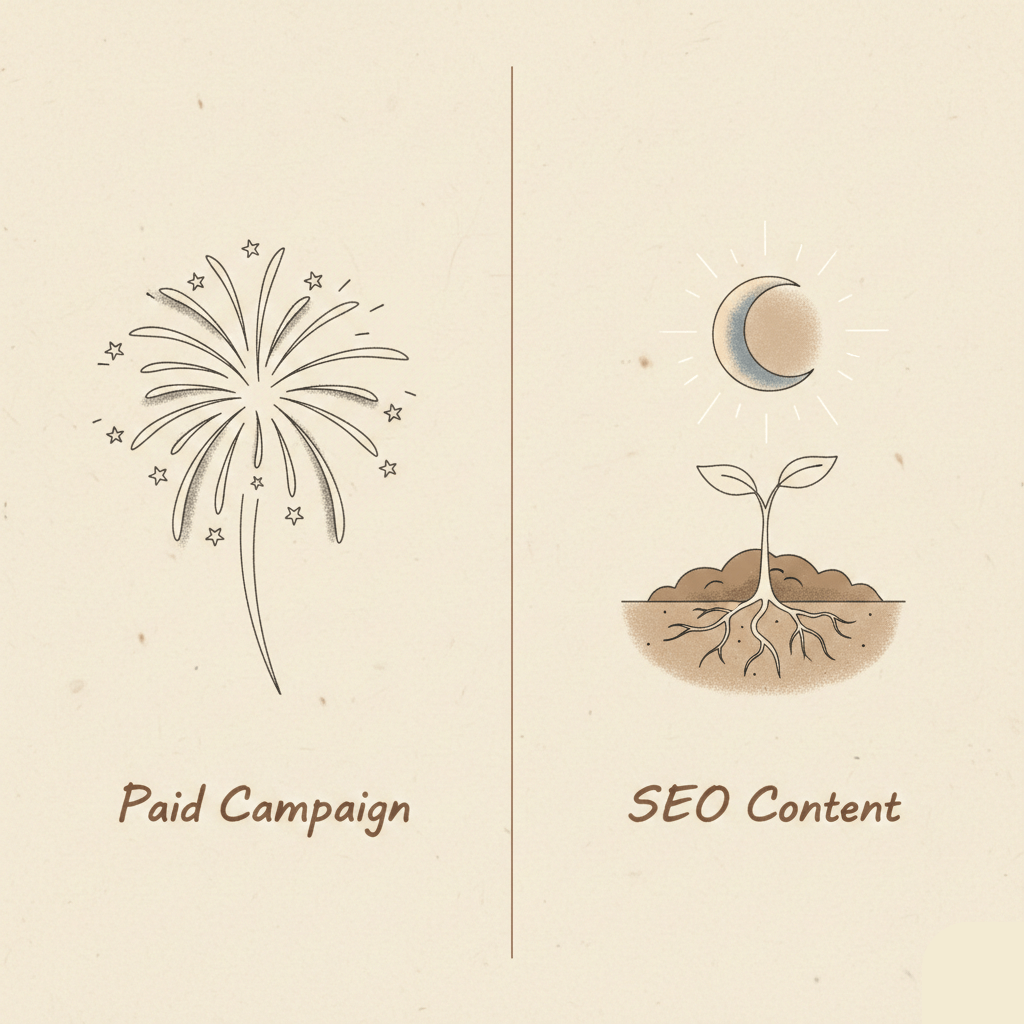
Scene. It’s 10pm and you’re staring at two charts: one shows a spike in signups after a paid campaign that vanished within 48 hours, the other shows a faint but steady incline of organic signups from a handful of blog posts you published months ago.
Which one would you rather own next quarter? That small, stubborn line is what happens when you grow your email list with SEO content—slow at first, but compounding into an asset. The paid spike buys speed, search builds durability.

Why SEO Content Should Power Email List Growth
There are two practical, and often conflated, approaches to list building. One treats content as a long‑term, intent‑driven acquisition system (SEO‑first). The other treats content as collateral for campaigns that generate quick leads (paid ads, partnerships, social).
The difference is structural. SEO buys you a compounding asset with content that continues to attract intent‑qualified visitors and converts them with tightly matched lead magnets. Campaigns buy you speed and signal.
The most defensible strategy is to build the SEO core and use paid and partnership channels as an acceleration and experimentation layer.
SEO vs Campaigns: Which Grows Your Email List Faster?
Both paths funnel people into the same goal — an email address — but they differ in timelines, research priorities and long‑term value.
Email List Growth: SEO Content vs Paid Campaigns
| Dimension | SEO‑Driven List Building | Campaign‑First / General Best Practices |
| Primary mechanism | Organic search visibility + intent‑matched lead magnets | Paid ads, influencer partnerships, giveaways, social traffic |
| Timeline | Long term (3–6+ months to see compounding returns) | Short term (days–weeks for visible signs) |
| Output quality | Higher average intent and lower acquisition cost over time | Fast growth but variable lead quality and higher churn |
| Research start | Keyword & intent research, content gaps | Audience & creative testing, platform insights |
| Sustainability | Builds domain authority and discoverability | Scales with budget/partnerships; stops when fuel stops |
This table is not an argument to abandon paid channels, it’s a map. Treat SEO as the system you invest in and campaigns as the rockets you strap on to test offers and accelerate winners.
How to Create SEO Content That Fuels Email Growth

Repurposing is what connects SEO and campaigns. The simplest way to grow your email list with SEO content is to start with a single intent-aligned blog post and design outputs that serve multiple channels and capture moments of intent.
Grow Your Email List with SEO Content Step by Step
- Publish an intent‑targeted post → Pick a long‑tail query that implies a task (e.g., “startup marketing templates”). Write to solve that task, not to win awards.
- Derivative assets → One tight lead magnet per article: an editable template, a checklist or a calculator that completes the searcher’s job. Create an indexable landing page for that asset under /resources/.
- Distributed signals → Produce a short explainer video, an infographic for visual search and internal links that cluster related pages around a pillar. Each piece feeds the main URL and the magnet.
The post attracts organic traffic, the magnet converts intent‑matched visitors and related pages widen the capture net and help rankings.
Using Paid Campaigns to Boost Email Signups Quickly
- Publish (or adapt) content as creative fuel → The blog is a script for ads and partnership assets rather than the primary traffic source.
- Paid & partnered derivative assets → Carousel ads, co‑branded guides with influencers or contest hooks drive immediate traffic to a single‑purpose landing page.
- Feed results back to SEO → Use the winning creative and copy from paid tests in your blog hero and CTA and route partnership traffic to the resource page to build link/usage signals.
You get fast signups, quick feedback on offers and creative inputs that can improve SEO conversions.
Practical SEO + Email Marketing Playbook for Fast Wins
Look at SEO as a system: research, publish, convert, measure, repeat. Below are the essential steps to walk through an SEO‑first list strategy.
Research SEO Keywords That Grow Your Email List
Start with seeds: product pages, competitor URLs and the tasks customers hire your product to solve. Expand those seeds into a scored keyword list: intent (informational/MOFU/BOFU), volume, difficulty and whether the query implies a downloadable asset (“template”, “checklist”, “calculator”). Prioritize BOFU/MOFU long‑tail queries you can realistically win.
Pair SEO Content with Lead Magnets That Convert
For each target query decide:
- The content format (guide, teardown, comparison).
- One tight lead magnet that completes the searcher’s job (editable file, mini‑course, calculator).
- CTA copy that promises the deliverable in the user’s language (e.g., “Download the editable budget sheet”).
Benchmarks to set early: baseline opt‑in 2 – 4% per page, target 5 – 10% with a tightly matched magnet.
Site Structure Tactics to Grow Your Business with SEO
Organize pillars at /topics/[theme] with spokes in the same folder. Every spoke links to the pillar and to 2 – 3 siblings using descriptive anchor text. Give every magnet an indexable landing page under /resources/ so it can earn long‑tail impressions and external links.
Offer placement: inline CTA after solving the “first mile” of the article, a sticky module on relevant pages and an exit‑intent for high‑intent pages only.
Publishing SEO Content That Captures Leads Early
New pages rarely jump to page one. Start with 3–4 clusters of long‑tail BOFU/MOFU queries to prove capture and secure early wins. Acquire a small number of relevant links (2–5) per pillar through partnerships or guest posts to improve time‑to‑rank.
Tracking SEO and Email Marketing Performance
In GA4 and Search Console build a saved view: Page URL → organic sessions → subscribers → opt‑in %. Use this to find the 20% of pages yielding 80% of signups and reinvest accordingly. Kill or replace magnets that perform poorly.
Success cadence for a small site (first 90 days): ship 12–16 posts across 3 clusters, publish 12 matching magnets, earn 6–10 relevant links to pillars and probe for 2–5% opt‑ins on your best pages while A/B testing CTAs to reach 5–10%.
Combine SEO and Paid Campaigns to Grow Online Leads
Paid channels and influencers are not substitutes for SEO. You can use them as tactical levers to test offers, accelerate winners and retarget missed visitors. They work best when layered on top of a system built to grow your email list with SEO content, ensuring every dollar spent compounds instead of resets.
Smart Paid Tests That Support SEO and Email Growth
- Run offer tests → A/B three magnet variants (template vs calculator vs swipe file) to the same landing page. Track CPL and subsequent email quality (opens, clicks, churn).
- Retarget SEO visitors → Build audiences from your top SEO pages and show ads that mirror the page’s CTA to capture return visits.
- CRO landing pages for paid → Keep forms to 1–2 fields, headline as the job promise and expect 5–15% submission on a clean single‑purpose page when offer fit is high.
Paid tells you what creative and offers resonate so feed those learnings back into your SEO hero, meta and magnet design.
Metrics That Matter: SEO Content and Email List Growth
Make measurement simple and actionable. Track these at a minimum:
- Per page: organic sessions, top queries, average position, email signups, opt‑in %.
- Per magnet: submissions, welcome email open/click, first 30‑day churn.
A few practical rules:
- Replace the magnet if opt‑in < 1% after 500 organic sessions.
- Improve title/meta if impressions are high and CTR is low.
- Double down on pages with >5% opt‑in and growing impressions.
Ready-to-Use SEO and Email Marketing Templates
Keyword Sheet Concept for Growing Online Leads with SEO
Keyword | Intent | SERP notes | Proposed magnet | Pillar/Spoke | Difficulty | Volume | Current rank | Priority
Fill from your keyword tool and prioritize MOFU/BOFU where you can ship a unique, task‑solving asset.
Page Brief Template: How to Create SEO Content
- H1 & SEO title (promise the outcome).
- Problem framing (what searcher is stuck on).
- First‑mile solution (steps 1–3).
- Inline CTA (“Copy the exact template we use”).
- Section outline (answer People‑Also‑Ask style questions).
- Internal links (pillar + 2 siblings).
- Magnet spec (format, fields, completion time, filename).
SEO Site Checklist to Grow Your Email List
- Pillars accessible from /topics or top nav.
- Spokes link up to the pillar and sideways to 2–3 spokes.
- Every resource has an indexable page under /resources/.
- Descriptive anchor text everywhere (avoid “click here”).
Email + SEO Growth Benchmarks to Track Success
Per page: organic sessions, email signups, opt‑in %, top queries, avg position.
Per magnet: submissions, welcome email open/click, first‑30‑day churn.
Kill/Keep rule reminder: <1% opt‑in after 500 sessions → replace the magnet.
90-Day Roadmap to Grow Your Email List with SEO

- Build a 3‑cluster roadmap (12–16 pages) where each page has a unique magnet tied to the query.
- Stand up /resources/ and wire event tracking for per‑URL opt‑ins.
- Launch two magnet variants on your top two pages and pick a winner.
- Use retargeting on visitors to those pages to capture missed signups.
- Reinvest in your top 3 performing pages (part‑2 article, toolized asset and 2–3 links to the pillar).
This sequence is intentionally unglamorous: research, ship, measure and compound.
SEO and Email Marketing: Long-Term Growth Strategy
If your priority is speed and you have budget to burn, campaign-first approaches will deliver fast leads often at predictable cost.
But if your priority is durability, cost-efficiency and higher-intent subscribers, the smarter path is to grow your email list with SEO content that compounds over time. Campaigns are the accelerant, SEO is the capital. Build both, but make your long-term decisions as if you will still be CEO in three years: which line on the chart would you rather wake up to?