
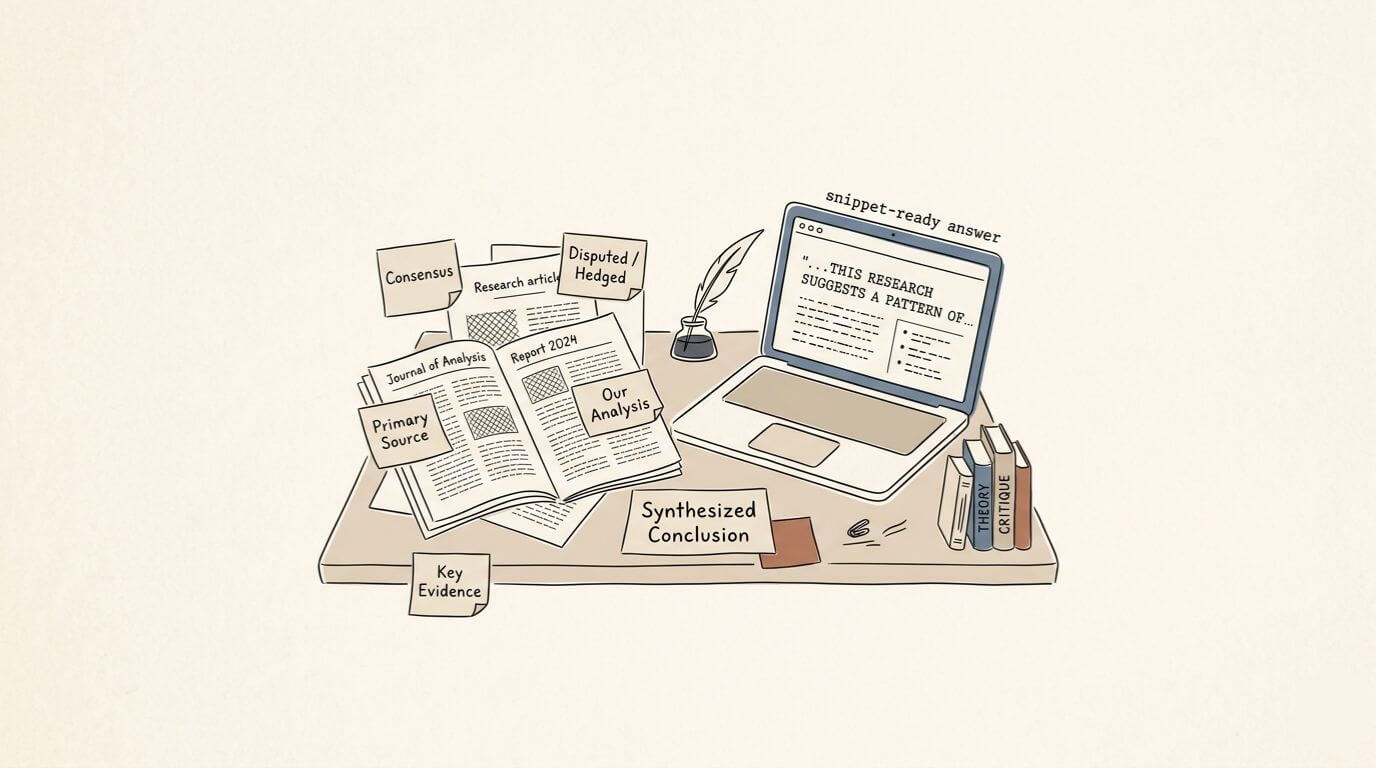
More and more search engines are being asked to do something philosophers have long argued over and that is deliver one best answer to complex questions. This is what we call a single answer search. What results is a battle between clarity and nuance, between what’s easy to verify and what may be true but novel.
Search engines reward clarity and consensus, as so they surface defensible answers that machines can verify and reproduce, because defensibility trumps philosophical truth for scalable, low-risk systems.
From Lists to Single Answers

Historically, search presented a ranked list with ten blue links that let users inspect competing claims. Modern interfaces such as featured snippets and AI overviews act like a single, compact answer delivered inline. Users often stop there. The “zero-click” behavior intensifies the incentive to design content that can be extracted as that one answer. If you’ve wondered why does Google show one answer in so many queries? That’s why.
Google’s public-facing product work shows this change. Recent features such as AI overviews and the Search Generative Experience aim to synthesize information into concise outputs that answer the user immediately. That design choice changes the signal the algorithms prioritize, with extractability and corroboration counting as more valuable than originality.
Field test: Take one question-style query from your Search Console Queries report and add a short, direct answer block near the top of the page. Check rankings and impressions again in a month.
What Counts as “Knowledge” for Machines
Search engines do not literally know or adjudicate truth in a philosophical sense. They compute signals that correlate with reliability across the web; things like repeated phrasing, citation overlap, semantic redundancy, consistent entity relationships, and historical user behavior.

These patterns become the algorithm’s “evidence.” When many independent pages make the same claim, using similar facts, citations and data points, a machine can confidently surface a single answer because the claim is machine-readable and low risk to present. In other words, trust forms from patterns machines can parse. It has nothing to do with human critical judgment. It’s a practical rule for systems that must serve billions of queries without adjudicating disputes.
For a claim to become the single surfaced answer it must be: (a) present in multiple, independent sources; (b) semantically aligned so extraction is robust; and (c) low risk for the platform to present.
“Defensibility” vs. “Truth”
Search engines optimize for defensibility rather than metaphysical truth. Defensibility is very much a practical property; can the system justify showing this answer using verifiable signals if later questioned?
Defensible answers have attributes that algorithms and human raters can validate like expert or institutional sources and corroborating citations. For public-interest or YMYL (Your Money or Your Life) topics, platforms explicitly avoid answers that contradict established expert consensus. That’s a policy decision to reduce harm and legal/PR risk, and it privileges consensus where one exists.
For example, when multiple institutional pages and review articles converge on a specific safety guideline, an algorithm can surface that guideline with low risk. Where evidence is mixed or emerging, the system will fragment or withhold a single declarative answer.
Field test: Search your target keyword and open the top 3 results. Count how many cite studies, official organizations, or expert authors, then compare that to your own page.
How Ambiguity Forces Hedging and Fragmentation
When no single, defensible answer exists, search systems respond in three predictable ways:
- Hedging: the system produces an answer that explicitly states uncertainty (e.g., “Experts differ on X; here are the main views”).
- Fragmentation: it displays multiple compact answers or a set of source cards so no single claim is privileged. Platforms are experimenting with showing several “quick answers” when consensus is absent.
- Omission / links-only: the engine may prefer sending the user to source documents rather than synthesizing a claim it cannot defend.
As observed, each choice is conservative. Better to present nuance or link out than to promote a contested single statement that could be wrong or misleading.

That’s why controversial or culturally contested queries rarely get a single answer. Instead, you’ll see multi-source panels, “people also ask” grids, and contextual notes. These are interface decisions meant signal uncertainty to human users while keeping system integrity intact.
Authority is Machine-readable and Networked
From the algorithm’s perspective, authority is not charisma or reputation in the human sense, but a property derived from machine-friendly signals:
- Citation overlap and link patterns: independent references pointing to the same data create redundancy machines can measure.
- Semantic reinforcement: multiple pages that phrase the same fact in different ways but map to the same entity relationships strengthen an extraction model’s confidence.
- User behavior signals: engagement, clicks, and repeat visits indicate that the community accepts this information as useful.
All these signals are additive. The clearer the networked evidence, the easier it is for an answer to be deemed “single best” by the system, the core of single answer search.
Online, human-facing reputation still matters, but only insofar as it produces machine-readable corroboration.
Field test: Run your page through a quick site:yourdomain.com + keyword search and see how many other pages on your site reference the same concept. More contextual mentions = stronger networked signals.
What This Means for Content Strategy
If search rewards defensibility, content strategy should aim to become the most defensible representation of a claim a machine can extract. This is not the same as chasing originality for its own sake.
Five high-level adjustments:
- Design for extractability: use straightforward headings and explicit Q&A pairs so that a snippet or AI model can pull an isolated claim and its supporting evidence.
- Signal consensus: cite multiple independent sources when you state a claim; show corroboration rather than lone insight.
- Create defensible claims: where you present an original insight, label it as an interpretation, and back it with evidence and a clear provenance trail.
- Manage ambiguity deliberately: if a topic is unsettled, surface competing positions and summarize the balance of evidence; that makes your content valuable and safer to surface.
- Optimize for the interface: think beyond the page. How will an AI overview or a knowledge card present your content? Tailor structure and metadata to those extraction patterns.

Write Content That Can Win the Single Best Answer Extraction
You can apply the sequence below to any article or page to improve its chance of being selected as a single, defensible answer.
- Start with the clear answer: put the concise, evidence-backed claim in an H2 or an opening paragraph formatted as a direct response to a likely query. Machines favor succinct, labeled answers.
- Provide numbered supporting facts: use short bullets or numbered lists of evidence (dates, figures, sources). Machine extraction models prefer discrete items.
- Cite corroborating sources inline: link to highly corroborated pages; if multiple independent sources agree, highlight that agreement.
- Mark novelty as interpretation: if you add original analysis, flag it explicitly: “Our interpretation” with supporting reasoning and citations. Also helps when trying to a get featured snippet or optimize content for AI overviews, since machines favor clearly labeled claims.
- Include a “Where disagreement remains” section: short, explicit bullets that list the unresolved questions and which authorities hold different views. It helps search present nuance instead of inventing it.
- Optimize for readability: use short paragraphs and clear headings, so both humans and extraction models benefit.
Field test: Open Google Search Console → Performance → Queries, pick one high-impression query, and check whether your page actually contains a single clear answer to that query in the first 100–150 words.
If this is speaking to you, I’ll send the next one when it’s ready.
Navigating Controversial or Ambiguous Queries
When topics are socially or scientifically disputed, the platform will prioritize safety and established consensus. That’s visible in product guidance; for public-interest categories (medical, civic, scientific) featured snippets should not contradict expert consensus. Platforms enforce that by design because the cost of amplifying fringe claims is high.
Strategy for creators:
- If you represent a mainstream, evidence-based view, anchor claims to recognized institutions and peer-reviewed sources.
- If you explore minority or novel perspectives, frame them as viewpoints and provide source: who holds this view, and why? Avoid language that presents a contested claim as settled fact.
- Use metadata and clear labeling (“opinion”, “analysis”, etc) so both users and machines can distinguish claims from interpretations.

The Interface Shapes Content More than You Might Expect
Search is as much of an index as it is an interface. The way answers are visually and functionally presented (snippets, AI overviews, cards, “people also ask”) changes the incentives for content creators.
If a search engine tends to synthesize answers, then being the clearest, most corroborated source matters more than the longest or most original essay. That affects editorial choices:
- Short, well-organized pages can outperform long-form pieces for extractable claims.
- Content that anticipates and fits the UI (e.g., clear Q&A blocks, concise lists) is more retrievable.
- E-E-A-T (Experience, Expertise, Authoritativeness, Trustworthiness) remains a guiding principle, but it’s the machine-readable expression of E-E-A-T that counts.
A 300–600-word page with a direct answer and three numbered supporting facts may be more likely to win a featured snippet or an AI overview than a 3,000-word exploratory essay that buries its conclusion.
Field test: Open your article and scan only the headings and lists. If someone (or a machine) read just those, would the main claim still be obvious?
Reconciling Originality and Retrievability
This is the most important cultural shift. Originality still matters for human readers and for building long-term authority, but to be the single answer in search you need to package originality as defensible interpretation.
A working model:
- Lead with consensus: show what established sources say.
- Add original insight as value-added analysis: explicitly separate it from the claim and back it with evidence.
- Make sourcing explicit: link to the sources that informed your insight and say why you interpret the evidence differently.
In this way, you preserve creativity while aligning with the extraction logic that governs single answer selection.

Risks and Ethical Considerations
This algorithmic tilt toward consensus can create distortions:
- Conformity bias: once a claim is surfaced as the single answer, subsequent creators may echo it, amplifying minor errors into de facto consensus.
- Visibility for majority views: marginalized or novel perspectives can be underrepresented even when they are correct.
- False confidence: users may accept single answers without following links to sources, reducing critical evaluation.
Designers and creators share responsibility. On one hand, platforms should surface provenance and uncertainty; on the other hand, creators should avoid packaging speculative claims as facts. The ethical challenge of search is in the balance between utility and epistemic humility.
Field test: In Google, search your topic + “criticism” or “controversy.” If credible counterpoints appear, consider whether your article should acknowledge them to avoid presenting a false consensus.
Content Templates for Single Best Answer
Here are ready-to-use templates that adapt to the single-answer environment.
A. Short direct answer (for fact queries)
- H1: [Question]
- H2: Short answer (1–2 sentences), the claim you want extracted.
- H3: Evidence (numbered list of 2–4 corroborating sources/facts).
- H3: Sources (linked institutional references).
- Schema: use
FAQorQAPageif multiple Q&As.
B. Balanced answer (for ambiguous queries)
- H1: [Question]
- H2: Short summary (1 sentence summary + note on uncertainty).
- H3: Why experts disagree (3 bullets, with sources).
- H3: Practical guidance (what users should do next).
- Schema:
QAPage+Claimmarkup for provenance.
C. Analysis + novel insight (for thought leadership)
- H1: [Topic / Claim]
- H2: Consensus baseline (what established sources say).
- H2: Our interpretation (label as analysis, provide stepwise argument, cite sources).
- H3: Evidence & reproducible data (figures, datasets, links).
- Schema:
Article+DatasetorClaimReviewwhere applicable.
Use these templates as an inspo to make extraction cleaner for machines, but do keep in mind the human reader. It has to work for them too.

Design for Clarity
The “single best answer” problem, central to single answer search, forces a reframing of content strategy. Search engines do not pursue philosophical truth; they pursue scalable, low-risk outputs that machines can justify. That favors corroboration and machine-readable authority.
The opportunity is to be both rigorous and readable. Produce content that is evidence-dense and structured so systems can extract defensible claims while preserving space for original thinking that is clearly marked as such.
If you want to influence what becomes the single best answer, don’t hide your reasoning. Make it visible, verifiable, and easy for both humans and algorithms to parse. The result will be content that ranks and can be trusted when search tries to speak with one voice.