Link-building for small businesses was never primarily about SEO anymore than cold-calling is about good sales.
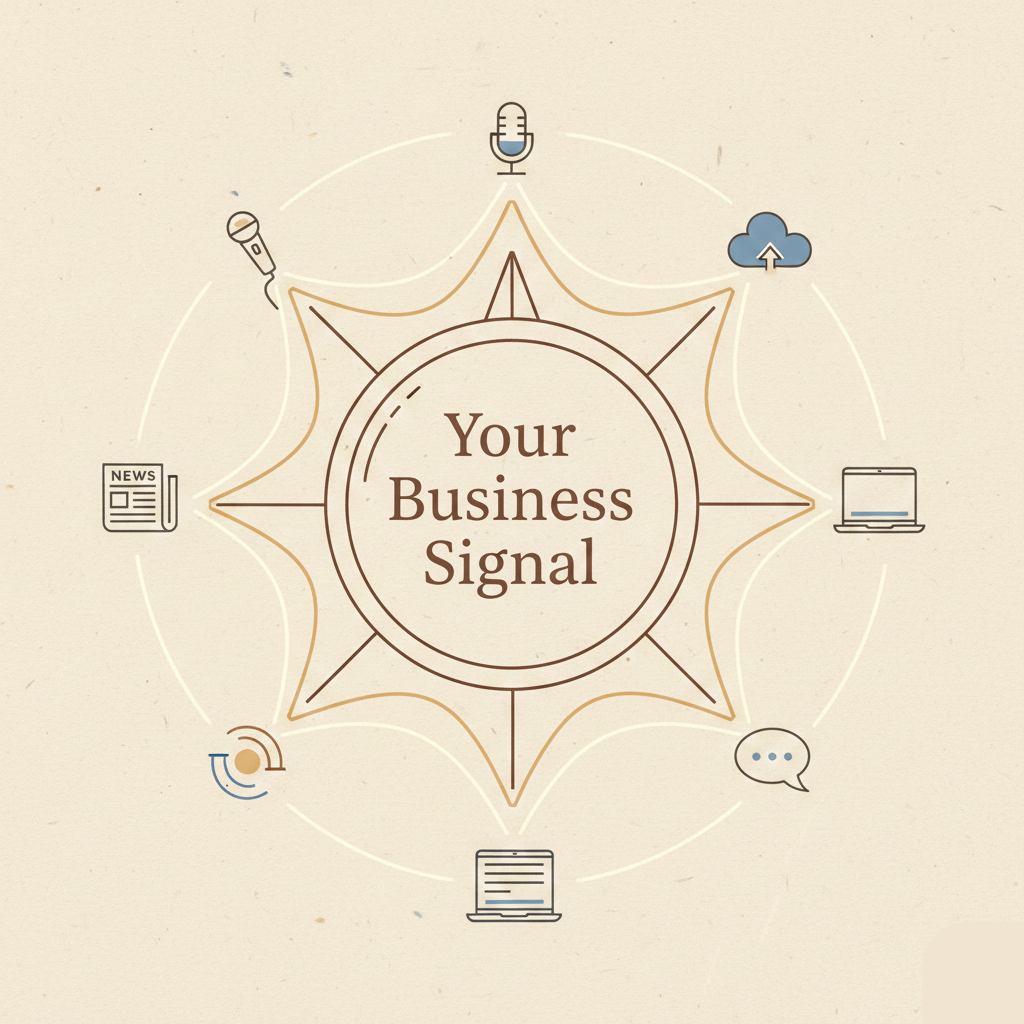
Today, small business media marketing should be understood as placing the business inside high-value narratives and data flows i.e., contexts that journalists, analysts, newsletters and search engines treat as authoritative.

For small businesses, the highest return comes from unique signal creation (original data, demonstrable expertise, local or niche authority) plus relationship amplification (trusted intermediaries, repeatable story formats).
Why Small Business Media Marketing Builds Trust and Authority
1. Search and media value are contextual. Search engines and newsroom editors surface content that answers user queries and supports stories, not link lists.
2. High-value contexts are signals to audiences and algorithms (brand mentions, quotes in industry reports, newsletter features, podcast interviews, dataset citations). Those signals scale trust more than anonymous links.
3. Small businesses have constrained resources and should therefore optimize for replicable, high-leverage moves (one good dataset, one recurring columnist relationship, one podcast series) rather than low-probability mass outreach.
High-Value Media Contexts That Power Small Business PR Wins
Trade/industry publications – strong relevance, audience intent, long shelf life.
National press/features – brand authority and big referral spikes (hard but high leverage).
Analyst reports / industry whitepapers – credibility that converts B2B buyers.
Newsletters (curated) – high open/click rates and persistent influence.
Podcasts & video interviews – long-form storytelling and searchable transcripts.
Local press / civic lists / business awards – great for small businesses with limited geographic scope.
Original data / benchmarks – usable by journalists and cited repeatedly (the single best scalable asset).
Academic / standards citations – rare but extremely authoritative for some niches.
Why Old Link-Building Fails in Modern Small Business Media Marketing
Simply put:
It treats links as an output rather than a byproduct of credible storytelling.
It often scales poorly as outreach volume ≠ quality placement.
It encourages gaming signals that algorithms now devalue.
It ignores the downstream conversion and brand-search effects which actually drive business value.
8-Step Small Business Media Marketing Playbook for Real PR Results
Step 1 – Find a Unique Story Signal for Small Business Media Coverage
Audit what you can produce that others can’t: a dataset, a method, an interesting customer cohort, a funny failure story with lessons. Make it small, defensible, and designed to stand out within your small business media marketing ecosystem.
Step 2 – Frame Story Angles That Get Your Small Business Mentioned
For each signal, write a 1-sentence hook for the journalist, one for analysts, and one for customers. Keep them distinct.
Step 3 – Build a One-Page Press Asset That Converts Media Attention
1 paragraph summary, 3 key data points, 2 quotes (CEO + customer), one high-res image, contact. Done. A compact format for your small business media marketing toolkit.

Step 4 – Use Smart Outreach to Strengthen Small Business Media Relationships
Identify 10–15 best fits (one newsletter editor, two trade writers, a local reporter, one podcast host). Personalize. Follow up once.
Step 5 – Offer Exclusives to Boost Small Business PR Pick-Up
For analysts or big outlets, offer a short embargo so they feel they have “first look.” Exclusives increase pick-up.
Step 6 – Amplify Small Business Media Coverage Through Owned Channels
Post the asset on your blog, embed data visualizations, tag journalists on social, syndicate to LinkedIn and industry Slack groups. Use Twitter/X carefully if relevant.
Step 7 – Use Journalist Match Platforms Wisely for Small Business PR
Help a Reporter Out is OK for quick quotes; prefer targeted pitches over volume responses.
Step 8 – Quick Pitch Templates for Small Business Media Outreach
Journalist subject line (short, hyper-specific):
Exclusive data: 12-month trend shows 40% drop in X among Y — can share dataset + founder quote
Two-sentence pitch body (for email):
Hi [Name], I’m [Name] from [Company]. We collected 12 months of anonymized transaction data from [niche] showing a 40% drop in X after Y — I can share the dataset, two charts, and a short quote from our founder if you’re interested in an exclusive. Best, [Name + phone]
Measure Small Business Media Marketing Success with Real PR Metrics
Primary:
- Branded search lift (baseline vs 30/90 days after placement).
- Referral traffic quality (% sessions with >1 pageview, conversions).
- Number of top-tier placements (tiered: national > trade > local).
- Secondary citations (how many other outlets cite you after the first placement).
Secondary:
- Backlinks from authoritative domains (as a byproduct, but not the goal).
- Social amplification (opens/clicks on newsletter placements).
Note: Don’t treat Domain Authority as a campaign KPI, use real business signals that reflect small business media marketing performance.
Perfect Timing: When to Pitch for Small Business Media Coverage
Pitch when your story matches an outlet’s editorial calendar and the newsroom’s capacity, not when you are ready.
Weekly rhythms matter (mid-week mornings), seasonal rhythms matter (planning cycles, gift-guide lead times, and vacation months), and “deadtimes” can be either opportunity or sink depending on the type of pitch and the relationship you’ve built.
Best days: mid-week (Tuesday–Thursday). Journalists plan early in the week and are more receptive then. Best window is your local morning (about 9:00–11:30 a.m.).
Avoid: very early Monday (catch-up), late Friday (weekend slack), and obvious holiday mornings. Follow up once, reasonably. many reporters prefer only one well-timed follow-up (3–7 days is common).
Seasonal PR Timing Tips for Small Business Media Campaigns
- Summer (Jun–Aug): staffing drops as reporters take vacations. Coverage volume is lower but competition can be lower too. If you have an established relationship, summer can be a good time to get eyeballs because editors need fresh content. But don’t expect big feature pieces unless you offer something very timely or exclusive.
- Autumn (Sep–Nov): newsrooms return from summer, editorial calendars ramp up, and outlets begin planning holiday gift guides; a prime window for major announcements and product placement pitches. Start pitching gift-guide material earlier.
- Holiday end-of-year (mid-Dec → early Jan): mixed. Some daily outlets still run, but many freelancers and lifestyle editors are done early. Avoid the week between Christmas and New Year’s for anything that’s not a New Year’s story. Instead, plan for early January follow-up when desks return.
- January–March: a good time for big, strategic announcements since newsrooms are re-energized and looking for fresh reporting angles.
Holiday vs. Deadtimes: When Small Business PR Pitches Perform Best
Ask three questions before you pitch:
- Is my story time-sensitive or evergreen? Time-sensitive → pitch to active windows; evergreen → summer/deadtimes can still be ideal for small business media marketing amplification.
- Who is my contact? Staff editor = earlier is okay; freelancer = earlier (they have deadlines). If you don’t have a relationship, avoid assuming deadtime equals easier pickup.
- What do I offer that’s scarce (exclusive, embargoed data, product sample)? Exclusives can overcome seasonal slack. Offer embargoes wisely to give larger outlets planning time.
Seasonal Pitch Templates for Small Business Media Opportunities
Summer outreach (relationship building):
Subject: Quick exclusive for [Outlet] — local dataset on X (short)
Body: Hi [Name], I know summers are light, so I wanted to offer an exclusive: a 3-chart dataset on [local trend] we collected from [n=…] that shows [key insight]. Happy to share the dataset and a 5-minute on-camera comment or a brief Q&A for background. No urgent deadline, just thought it might help your summer coverage. [Name]
Holiday gift-guide pitch (early):
Subject: For your holiday gift guides — tested [product] that hits [audience]
Body: Hi [Name], quick note: we’ve tested [product] with [n] users and it scores highly on [metric]. I know guides are being planned now; I can send sample units, press photos, and user quotes by [date]. Happy to offer a short exclusive window if helpful. [Name]
6-Month Readiness Checklist for Small Business Media Marketing Success
Before you chase high-value mentions, treat readiness as a binary risk filter. Either you’re prepared to earn the attention (serve the audience that outlet will send you) or you shouldn’t pitch. Poor readiness wastes newsroom goodwill and damages credibility.
Score Your Small Business Media Readiness Before You Pitch
Score 0 = missing or broken; 1 = present but weak; 2 = strong and tested.
Add points; maximum = 20.
- Signal / Offer (the thing you’re pitching: dataset, study, product, case study)
0 = no clear, defensible signal; 1 = signal exists but small sample/unclear method; 2 = unique, documented, and journalist/analyst-ready. - Press asset & visuals (1-pager, images, charts)
0 = no asset; 1 = asset exists but flaky visuals or missing quotes; 2 = concise one-pager + 3 ready visuals + alt text. - Website health (mobile, HTTPS, no 404s)
0 = site has critical errors or slow mobile; 1 = mostly fine but some UX issues; 2 = fast, mobile-first, HTTPS, canonical tags, accessible. - Landing page & conversion funnel (dedicated landing with UTM + clear CTA)
0 = generic homepage only; 1 = landing page but no UTM/form; 2 = landing page with UTM links, minimal form, thank-you flow and tracking. - Analytics & tracking (events, UTM, CRM integration)
0 = no analytics or blocked; 1 = basic analytics but no conversion events or CRM tagging; 2 = UTM + goal events + CRM mapping in place. - Lead handling / fulfillment (can you respond to leads within X hours? sample flows)
0 = no plan; 1 = plan exists but low capacity; 2 = SLA defined (e.g., 24h response), staff assigned, templates ready. - Email / owned amplification (newsletter, social presences ready)
0 = no list or dormant channels; 1 = active list but low cadence; 2 = engaged list + ready amplification sequence. - Spokesperson & media governance (trained quoted person, approval workflow)
0 = no spokesperson or unclear approvals; 1 = spokesperson identified but not media trained; 2 = trained spokesperson + approvals and quote library. - Legal / compliance & data hygiene (consent, sample sizes, disclosures)
0 = unknown compliance; 1 = some documentation but gaps; 2 = method/workflow documented and legal OK. - Customer-support & PR incident plan (FAQ, reactive comms)
0 = nothing; 1 = FAQ exists but not tested; 2 = FAQ, prepared responses for negative press, escalation path.
Scoring guidance:
- 16–20 (Green) → Go: launch outreach.
- 11–15 (Yellow) → Conditional: fix 1–3 highest-impact gaps before pitching.
- 0–10 (Red) → Hold: spend 4–8 weeks on readiness work before outreach.
The Must-Have Assets Before Any Small Business Media Outreach

If you can only do a few things, make sure you have all five below. These form your small business media marketing minimum viable setup:
- One-page press asset (headline, 3 bullet takeaways, 2 quotes, 1 dataset or chart, contact info).
- Dedicated landing page with UTM-ready URLs, short form (name + email + optional phone), Thank-you page that triggers an event.
- Media kit folder (high-res logo, 2 founder headshots, one product shot, brand colors/typography).
- Analytics & CRM mapping (UTM structure + event names + CRM field mapping).
- At least one trained spokesperson and a prepared 2-sentence boilerplate + 1-paragraph company description.
If any of these is missing, reschedule outreach until they are in place.
Track Small Business Media Marketing Results with Simple UTM Setup
Use this UTM pattern for all outreach:
?utm_source=[outlet]&utm_medium=press&utm_campaign=[campaign_slug]&utm_content=[pitch_variant]
Example:
?utm_source=tradeX&utm_medium=press&utm_campaign=summer_dataset2025&utm_content=exclusive
Map these UTMs to analytics goals and CRM lead source fields.
Follow-Up Templates That Strengthen Small Business Media Relationships
One-sentence boilerplate (company bio):
[Company] is a [what you do in 5 words] serving [audience] with [key differentiator]. Founded in [year], we [one result metric].
Quick “after-publication” outreach to author (short):
Subject: Thanks — quick amplification ask
Body: Hi [Name], thanks for the piece — truly appreciated. If useful, we can share an official social card or a tweet thread to help amplify. Also, any chance you can add a canonical link to our dataset at [URL]? Thanks again, [Name, role, contact].
Response to a negative claim (3 lines):
We’re sorry to hear this. We stand by our methodology (summary sentence + link to methods). We’d welcome a private conversation to clarify facts and correct any errors; available today/tomorrow at [times]. [Name, contact]
KPIs to Track Small Business Media Marketing Performance
Primary (first 30–90 days):
- Number of top-tier placements (count, tiered).
- Branded search volume change (baseline → 30/90 days).
- Referral leads from placement (UTM tracked).
- Conversion rate from placement landing page (form completions / visits).
Secondary (value signals):
- Secondary citations (how many other outlets/voices picked up).
- Newsletter signups driven by placements.
- Social engagement on posts amplifying the placement.
Collect these weekly during Month 4–6 and summarize in a single slide for decision makers.
Own Your Content First: Smart Syndication for Small Business PR
Own the canonical asset on your domain first (that’s where the long-term SEO, analytics and lead capture should live). Then extend it through co-created, syndicated, or partner-hosted variants, core tactics in scalable small business media marketing.
Top Investments That Maximize Small Business Media Marketing ROI
These are the resource buckets you should fund for a full 6-month campaign. Priorities assume a small team and limited budget. Read top → bottom as “do this first.”
- Core content & signal production
- What: original research/benchmark, curriculum sample, micro-course, interactive demo, case-study pack, instructor interviews, or tested lesson plans.
- Why: this is the currency journalists and newsletters use. Make it defensible (method, sample size) and re-usable.
- What: original research/benchmark, curriculum sample, micro-course, interactive demo, case-study pack, instructor interviews, or tested lesson plans.
- Landing page & canonical experience
- What: a dedicated, fast, mobile-first landing page with a single CTA, downloadable assets, and embedded media (slides, charts, transcript).
- Why: capture, measure, and convert referral traffic; establish canonical source.
- What: a dedicated, fast, mobile-first landing page with a single CTA, downloadable assets, and embedded media (slides, charts, transcript).
- Analytics, tracking & CRM
- What: UTM conventions, event tracking, form → CRM mapping, lead scoring fields, simple dashboard.
- Why: attribute campaign ROI and qualify incoming leads quickly.
- What: UTM conventions, event tracking, form → CRM mapping, lead scoring fields, simple dashboard.
- Design & media (high-quality visuals)
- What: charts, one-pager PDF, press images, social cards, short video or animated explainer, slide deck.
- Why: high-value placements expect polish; poor visuals kill pickup and diminish credibility.
- What: charts, one-pager PDF, press images, social cards, short video or animated explainer, slide deck.
- Media relations & outreach capacity
- What: a part-time PR lead or hourly freelance outreach specialist (someone who can personalize pitches, maintain relationships, and manage follow-ups).
- Why: human relationships still decide pickups; outreach volume is far less important than relevance and persistence.
- What: a part-time PR lead or hourly freelance outreach specialist (someone who can personalize pitches, maintain relationships, and manage follow-ups).
- Spokesperson time & training
- What: media training, a quotes library, prepared soundbites, calendar availability for interviews.
- Why: quick, confident responses increase the chance of favorable coverage.
- What: media training, a quotes library, prepared soundbites, calendar availability for interviews.
- Owned-channel amplification
- What: newsletter sequencing, social posts, webinar or short live demo series, repackaging into blog posts.
- Why: outlets prefer assets that can be amplified; this also converts and prolongs the life of coverage.
- What: newsletter sequencing, social posts, webinar or short live demo series, repackaging into blog posts.
- Partner & syndication resources
- What: guest-post drafts, co-branded slide decks, embeddable data visualizations (iframe/code), sample curriculum for partner sites.
- Why: makes it frictionless for partners to publish or embed your material.
- What: guest-post drafts, co-branded slide decks, embeddable data visualizations (iframe/code), sample curriculum for partner sites.
- Measurement & optimization budget
- What: time / tooling for weekly KPI checks, A/B test headline variants, and refine targeting.
- Why: ensures you learn and improve quickly; prevents repeating mistakes.
- What: time / tooling for weekly KPI checks, A/B test headline variants, and refine targeting.
- Optional: paid buys & sponsorships
- What: newsletter sponsorships, promoted placements, small paid social boosts for top placements.
- Why: use sparingly to amplify earned coverage or to seed a test with a strategic partner.
- What: newsletter sponsorships, promoted placements, small paid social boosts for top placements.
Who Does What in a Small Business Media Marketing Campaign
For a small shop, roles can be fractional-time or outsourced. This is normal in small business media marketing campaigns:
- Campaign lead (internal) – owns strategy, prioritization, and spokes/approvals.
- Content lead – designs the study, writes the report, produces curriculum artifacts.
- Designer / developer (contract) – landing page + visuals + micro-interactives.
- PR/outreach specialist (contract or part-time) – journalist list, personalized outreach, follow-up.
- Analytics/ops (internal or contractor) – GTM/analytics, UTM mapping, CRM automation.
- Media-trained spokesperson – founder or senior educator available for rapid interviews.
- Amplification owner – newsletter + social scheduling + webinar host.
When to Host or Partner in Small Business Media Campaigns
Decision rule: host on your site when…
- You need to capture leads and control the canonical source.
- You plan to re-use the asset (webinar, paid course funnel, evergreen marketing).
- You want full analytics and the ability to iterate.
Consider partner-hosting when…
- The partner’s distribution, trust and relevance orders-of-magnitude exceed your owned reach and they will drive measurable conversions you can track.
- The partner offers co-publishing that includes metrics access, a newsletter feature, or a paid promotion that’s cost-effective.
- You can secure explicit attribution, a clear CTA linking back to your landing page, and (ideally) access to first-party referral metrics from the partner.
Negotiation Must-Haves for Small Business Media Co-Publishing
Always get these in writing (e-mail ok) before publication:
- Byline & attribution – your company name in the byline or a co-authorship line.
- Canonical/linking agreement – a prominent link back to the canonical landing page; if they host the full content, request a rel=canonical pointing to your URL or a “republished from” canonical clause.
- Newsletter inclusion – a single dedicated sentence or placement in the partner’s next newsletter.
- Social amplification – 2 social posts (one on publish, one later).
- Metrics access – open click/impression numbers, or a short analytics report within 7 days.
- Syndication rights – permission to republish a slightly abbreviated version on your domain after X days.
- Exclusivity window (if requested) – if you provide an exclusive, negotiate a short embargo (e.g., 48–72 hours) and require post-publication syndication rights.
One-Page Small Business Media Marketing Checklist
- Canonical landing page with form + UTM-ready links
- One-page press asset + 3 visuals + methods paragraph
- Embeddable visual (iframe) + slide deck + speaker notes
- Media kit folder (headshots, logos, bios)
- Analytics + CRM mapping + dashboard template
- Named spokesperson + media training session done
- Outreach list with 10–15 prioritized partners and target asks
- Contract template or email playbook for co-publishing terms
- Amplification plan (newsletter + social + paid amplification)
Resource Guide: Choosing the Right Small Business Media Marketing Assets
Below I rank common resource types on a 1→5 difficulty scale (1 = cheap & quick; 5 = complex & costly).
Each resource is framed in terms of small business media marketing ROI, production effort versus editorial pickup potential.
Score key (quick)
1 — very low cost & fast (one person, hours–days)
2 — low cost (small team, days–2 weeks)
3 — medium (cross-functional, 2–6 weeks)
4 — high (multi-resource, 6–12 weeks)
5 — enterprise (heavy research/dev, 3+ months)
1. Short vlog / explainer video (Score: 1–2)
- Time: 1–10 days (script → shoot → edit).
- Roles: 1 presenter, 1 editor (or DIY tool), basic mic/camera.
- Pickup potential: Low→Medium – useful for social and owned channels; weak standalone journalist value unless paired with data or a timely hook.
- Reusability: Medium (clips, GIFs, transcript → blog post).
- Why it works: shows product in use, provides quick proof of concept.
- How to make it pick-up-worthy: include a compelling data point or a business result (e.g., “improved quiz scores by X% in 4 weeks”), supply transcript and short embed code, and offer 30–60 second clips for newsletters/podcasts.
- Tip: produce a 90–120s “newsroom-ready” clip + 10s teaser; include a clear CTA and a downloadable one-pager link.
2. Short case study / teacher testimonial (Score: 2)
- Time: 1–3 weeks.
- Roles: product owner, interviewer, writer, designer (for one-pager).
- Pickup potential: Medium – strong for trade outlets, local press, and newsletters when the case illustrates a broader trend or solves a common problem.
- Reusability: High (slides, quotes, podcast segment, classroom handout).
- Why it works: real-world outcomes deploy credibility and relatable narrative.
- How to make it pick-up-worthy: quantify impact, anonymize data properly, include teacher quote and short video clip, present both before/after metrics.
- Tip: prepare a short “press quote” and a 1-page PDF that journalists can link to or embed.
3. How-to longform guide / lesson-plan toolkit (Score: 3)
- Time: 2–6 weeks.
- Roles: instructional designer, subject-matter expert, editor, designer.
- Pickup potential: Medium→High – very attractive to publications and niche newsletters if it solves a frequent problem.
- Reusability: Very high (evergreen resource, gated/un-gated variants).
- Why it works: high utility for the shared audience, directly usable by readers.
- How to make it pick-up-worthy: include tested scripts, printable sheets, and customer outcomes; provide a downloadable zip and a one-page summary for journalists.
- Tip: attach a founder quote and an anonymized mini-dataset showing improvement, plus a short explainer video, hallmarks of professional small business media marketing.
4. Benchmark report / original dataset & analysis (Score: 4)
- Time: 6–12 weeks.
- Roles: data analyst, researcher, writer, designer, PR lead.
- Pickup potential: High – journalists love proprietary data, trades will cite it, newsletters run it, and it can spawn multiple pitches.
- Reusability: Very high (slides, press release, webinars, blog series).
- Why it works: scarcity and defensibility – original numbers are citation fodder.
- How to make it pick-up-worthy: rigorous methodology section, sample size and limitations up front, data download (CSV), clear visualizations, and an embargo/exclusive strategy for top targets.
- Tip: offer an exclusive to one high-value outlet under embargo, then syndicate; supply pre-made charts and pull-quotes for journalists.
5. Interactive diagnostic / micro-course with analytics & study (Score: 5)
- Time: 3–6+ months.
- Roles: product dev, UX, data engineer, researcher, instructional designer, marketing, PR.
- Pickup potential: Very High – if the diagnostic is genuinely useful and produces aggregated insights, it can be syndicated, used for conference presentations, cited in reports.
- Reusability: Excellent (continuous data stream, iterative content).
- Why it works: combines product trial, engagement data, and an original signal you can sample in reports.
- How to make it pick-up-worthy: publish an initial study based on early users (method + N), provide case studies, offer partner co-branded versions with distribution partners.
- Tip: build instrumentation so that participation creates anonymized, exportable datasets you can analyze for pressable insights.
6. Co-branded webinar / PD series with partner (Score: 3–4)
- Time: 4–8 weeks to coordinate and produce.
- Roles: host, partner liaison, slide designer, ops.
- Pickup potential: Medium→High – excellent for newsletter pick-up and trade coverage if the partner has credibility and promotes it.
- Reusability: High (recording → gated replay).
- How to make it pick-up-worthy: offer PD credits, include a short dataset or case study during the webinar, and provide a clear press-friendly synopsis and assets for partner promotion.
- Tip: negotiate newsletter inclusion and access to partner metrics in advance, a key metric in collaborative small business media marketing.
7. Co-published research with an institutional partner (Score: 4–5)
- Time: 3–6 months.
- Roles: research partners (university/NGO), project manager, data analyst, PR.
- Pickup potential: Very High – institutional partners confer authority and distribution; excellent for top-tier trade and some national press.
- Reusability: High (citable report, conference presentations).
- How to make it pick-up-worthy: rigorous IRB or data privacy checks, co-branding and joint press plan, and a clear embargo/first-look agreement.
- Tip: secure partner metrics commitments and a joint amplification plan.
8. Slide deck + speaker notes for conferences (Score: 2–3)
- Time: 1–4 weeks.
- Roles: presenter, designer, copy editor.
- Pickup potential: Medium – conference presence signals credibility and can lead to trade coverage; slides can be republished by partners.
- Reusability: Medium (slides → blog → mini guide).
- Tip: publish slides with an embedded link back to canonical landing and a short one-page summary for press.
6-Month Small Business Media Marketing Roadmap
Given limited staff/time, and assuming your goal is high-value mentions and lead capture:
- Month 0–1: Produce a strong case study + 1-page press asset (Score 2). Quick path to trade pick-up and local press; builds credibility.
- Month 1–3: Build and launch a how-to toolkit (Score 3) that includes a short study (before/after). Pitch trade outlets and newsletters.
- Month 3–6: Run a mini-benchmark using your user base or partners (Score 4). Offer an exclusive embargo to one trade outlet, then syndicate. Use data for multiple follow-up pieces (webinar, guest post, social series).
- Parallel (ongoing): Produce short vlog clips from case studies to amplify placements quickly (Score 1).
This path gives early credibility fast, creates a highly usable asset, then culminates in defensible proprietary data that can attract bigger outlets.
Rapid templates (copy-paste ready)
Vlog blurb (for outreach / embed):
Short clip: “How [Product] helped Ms. [Name] reduce grading time by 30%” — 90s video + downloadable lesson plan. Embed: [link]. Contact: [name].
Case study headline + subhead:
Case study: “How Lincoln Middle School raised formative assessment scores 18% in 6 weeks using [Product].”
Subhead: “Small pilot (n=120 students) + teacher coaching; includes downloadable lesson plan and raw pre/post results.”
Benchmark press summary (1 paragraph):
New 10-week benchmark of classroom formative assessments (n=450) shows X% change in [metric]. Full report includes methodology, CSV download and teacher interviews. Available under embargo until [date]. Contact: [PR name, phone, email].
Each of these supports discoverability and credibility inside a small business media marketing campaign.
Digital PR vs Networking: How Small Business Media Marketing Differs
Digital PR is campaign-driven, asset-centric, and output-measured; business networking is relationship-driven, opportunity-oriented, and process-flexible.

You can reuse networking techniques inside digital PR (and you should), but you must treat PR like a project with gates, SLAs, and amplification commitments. This is not an endless sequence of “let’s grab coffee” conversations.
Small Business Media Marketing vs Networking: Key Differences
| Dimension | Business networking (LinkedIn/Slack/cold intro) | Digital PR campaign |
| Primary goal | Build relationships, referrals, partnerships | Earned placements, mentions, citations, measured conversions |
| Time horizon | Open-ended, relationship-first | Fixed campaign window (weeks → months) with milestones |
| Speed to agreement | Fast (informal) | Slower; often needs written terms, embargoes, or exclusives |
| Formality | Low; DMs, coffee chats | Medium–High; emails, briefs, contracts, press assets |
| Deliverables | Conversation, intro, mutual help | Content asset, media kit, landing page, analytics, promotion plan |
| Approval process | Ad hoc | Defined: draft → review → signoff with set turnaround times |
| Promotion expectations | Usually none or ad-hoc | Explicit: newsletter, social posts, embed, tracking links |
| Measurement | Referral or subjective value | KPIs (UTM leads, placements, branded-search lift, citations) |
| Scalability | Highly scalable relationship-wise (many weak ties) | Partly scalable (templates + processes) but relationship work limits top-tier scale |
| Risk | Low reputational & operational risk | Higher risk if you’re not prepared (traffic spikes, bad quotes, data challenges) |
Realistic Small Business Media Marketing Timelines That Work
Simple guest post / newsletter mention (small partner)
- Reach-out → interest: 3–7 business days
- Draft delivery (you): 3–7 days after signed agreement or confirmation
- Partner edits / approval: 3–5 business days
- Publish & promote: within 2–5 business days of approval
Total: ~2–4 weeks
Co-published benchmark report / exclusive with mid-tier trade
- Outreach & negotiation: 1–3 weeks
- Research & draft: 4–8 weeks (parallel prep recommended)
- Embargo / exclusive negotiation: agree 48–72 hours window in writing
- Partner review & legal checks: 1–3 weeks (depends on org)
- Publish & joint promotion: coordinated day-of actions + 7–14 day follow-through
Total: ~8–14+ weeks
National/Top-tier exclusive or institutional research co-pub
- Outreach & partnership terms: 2–6 weeks
- Research & IRB/legal compliance: 2–6 months
- Co-approval and embargo: 2–4 weeks
- Publish & amplification: multi-channel, 30+ day campaign
Total: 3+ months
Approval Templates for Smooth Small Business Media Collaborations
Pre-sign: quick checklist (must be green before signing)
- Canonical landing page live & UTM-ready ✔
- Press one-pager + visuals prepared ✔
- Spokesperson availability windows (48–72h post-pub) ✔
- Analytics tracking & CRM mapping validated ✔
Sample SLA for partner email (key parts)
- Draft delivery by: [date] (Owner: Company)
- Partner editorial review completed by: [date + X days] (Owner: Partner)
- Final signoff (last changes accepted) by: [date + Y days] (Both)
- Agreed publish date: [date]
- Promotion commitments (day 0 / day 3 / day 7): Partner will send newsletter mention on day 0 and 1 social post on day 0; Company will amplify across owned channels day 0–7.
- Metrics: Partner will provide click & open metrics within 7 days of publish.
- Exclusivity: [optional: 48–72 hour exclusive to Partner]
- Termination: If partner misses publish window by >7 days without agreed extension, Company may publish canonical on own domain.
Use email to capture agreement (no need for formal contract for small partners), but for mid/large partners get a short written agreement or MoU.
Qualify and Nurture Small Business Media Prospects Effectively
When a middle- or high-value prospect (editor, newsletter, partner) lands in your funnel, act like a project manager.
1) Fast triage (within 24 hours)
- Identify prospect type: staff editor / freelancer / newsletter curator / institutional partner.
- Score their value (see rubric below).
- Respond with a single short reply confirming interest and offering two concrete next steps: a) 10–minute discovery call, or b) immediate access to a one-page asset under embargo.
Structured responsiveness is what turns good PR into effective small business media marketing.
Prospect scoring rubric (0–10 each; threshold ≥18 to treat as high-value)
- Relevance (0–10): audience alignment with your product/user.
- Reach (0–10): newsletter subs / outlet monthly uniques / audience quality.
- Distribution control (0–10): ability to include newsletter + social + report metrics.
- Relationship warmth (0–10): intro vs cold outreach vs prior contact.
- Metrics access willingness (0–10): will they share clicks/impressions?
Example: Relevance 8 + Reach 6 + Distribution 7 + Warmth 4 + Metrics 5 = 30 (high-value)
2) Fast qualification reply template (use in email / DM)
Hi [Name] – thanks so much. We have a short dataset + one-page press asset ready. Would you prefer (A) a 10-minute call to discuss an exclusive embargo window, or (B) I can email the asset now under a 48-hour embargo? Both routes come with UTM links and a short explainer for your readers. [Name]
3) If green (high-value): accelerate into campaign flow
- Book call within 3 business days.
- Send asset + methods + suggested pull-quotes within 24 hours of call.
- Provide calendar for spokesperson within 48–72 hours of agreed publish window.
- Track in campaign sheet (status: contacted → interest → exclusive → draft → approved → published → metrics).
4) If yellow (medium-value): nurture via networking
- Add to a “nurture” list for future pitches; send occasional high-value updates (monthly).
- Use Slack/LinkedIn to share small wins or relevant short assets — avoid heavy asks during first month.
5) If red (low-value): automate
- Send an automated “press kit” email with asset link, embed codes, and CTA to request interviews; no exclusives offered.
Approval Workflows That Keep Small Business Media Campaigns On Track
- You prepare canonical draft (T0).
- Provide partner a “media-ready” draft and 3 suggested pull-quotes. (Delivery: T0 + 2–5 days)
- Provide partner a “media-ready” draft and 3 suggested pull-quotes. (Delivery: T0 + 2–5 days)
- Partner editorial review (T1).
- Partner returns edits within agreed 3–7 business days. If more time is needed, they must request extension and propose new date.
- Partner returns edits within agreed 3–7 business days. If more time is needed, they must request extension and propose new date.
- Legal/Compliance (if needed) (T2).
- Any legal checks must be listed at negotiation; allow 5–10 business days for institutional partners.
- Any legal checks must be listed at negotiation; allow 5–10 business days for institutional partners.
- Final signoff (T3).
- Final version delivered and approved by both parties no later than 48 hours before publish.
- Final version delivered and approved by both parties no later than 48 hours before publish.
- Day-of publish & promo (T4).
- Partner performs agreed promotions; you execute owned-channel amplification simultaneously.
- Partner performs agreed promotions; you execute owned-channel amplification simultaneously.
- Metrics & post-mortem (T5).
- Partner shares initial metrics within 7 days; both parties hold a 30-minute debrief within 14 days to capture learnings and next steps.
Promotion Cadence: Sustaining Momentum in Small Business Media Marketing
- Pre-publish (72–48 hours): confirm embargo window, send final assets, schedule social copy.
- Day-of publish (D0): partner newsletter (if promised), partner social posts, your social + newsletter + blog post, tag partner and author.
- D1–D7: amplify via targeted paid boosts for the best-performing post (if budget allows), repurpose into short clips or pull-quote images.
- D7–D30: follow-up outreach to secondary outlets using coverage as proof; publish a case-study on your site summarizing impact and linking back to the partner piece.
- D30–D90: convert referral traffic to leads via drip email + webinar invite; measure branded-search lift and secondary citations.
Why Small Business Media Marketing Outperforms Cold Outreach
Cold email / LinkedIn
- Tone: conversational, exploratory.
- Ask: warm intro, request meeting, share short asset link.
- Agreement & timelines: informal, often none.
- Approvals: minimal.
- Promotion: usually none; relationship focus.
- Outcome: relationship or intro; long timeline to measurable business results.
Digital PR
- Tone: concise, newsroom-ready, asset-first.
- Ask: publish/mention with metrics or exclusive.
- Agreement & timelines: explicit (embargo, signoff, metrics).
- Approvals: formalized.
- Promotion: explicitly planned & measured.
- Outcome: measured placements, citations, and conversion.
Example outreach lines for contrast
Cold LinkedIn message:
Hi [Name], love your recent piece on classroom tech. I run a small edtech company — would you be open to a quick chat about what we’re seeing with teachers?
Digital PR pitch (email):
Subject: Exclusive: 6-week classroom benchmark (n=450) — can share embargoed report + 3 charts
Hi [Name], we ran a 6-week pilot showing X% improvement in formative assessments. I can offer you an exclusive embargoed report (CSV + charts + teacher quotes) and a 10-minute call with our lead researcher ahead of publish. If interested, I can send the asset under a 48-hour embargo. —[Name]
Scaling Small Business Media Marketing Without Losing Quality
Short answer: partly scalable.
- Scalable elements: templates (press one-pager, UTM links), automated follow-up sequences, repackaging assets, embeddable charts, and low-touch syndication deals. These let you run many small outreach attempts quickly.
- Non-scalable elements: high-value exclusives, bespoke co-publishing negotiations, legal/compliance reviews, and relationship cultivation with top-tier outlets. These require human time and can’t be fully automated without quality loss.
Practical rule-of-thumb for team sizing: for every 1 FTE PR/outreach person, plan to manage ~10–20 high-quality bespoke relationships + 50–100 lower-touch outreaches per quarter.
If you want more top-tier pickups, add another experienced PR person or an agency, especially if you’re scaling small business media marketing across multiple verticals.
Final Checklist: Turning Media Prospects into Small Business PR Wins
- Triage prospect within 24 hours (use scoring rubric).
- Confirm asset readiness (canonical URL, UTMs, press one-pager).
- Offer 2 concrete next steps (call or embargoed asset) in first reply.
- Book call within 3 business days for green prospects.
- Provide draft + pull-quotes within 48 hours post-call.
- Agree on publish date, promotion commitments, and metrics access in writing.
- Ensure spokesperson calendar blocks for 48–72h after publish.
- Day-of: execute amplification plan and monitor analytics in real time.
- Post-pub: request metrics within 7 days and schedule a 30-minute debrief within 14 days.
Conclusion
At its core, small business media marketing is the disciplined practice of earning credible visibility through relevance, originality, and participation in trusted informational flows.
For small enterprises, the goal is contextual presence, appearing where meaningful conversations already occur. That requires a combination of empirical awareness (what the data shows about reach and resonance) and narrative literacy (how stories circulate, refract, and persist). When those two capabilities meet, visibility becomes cumulative.
In that sense, small business media marketing represents a maturation of digital PR itself: a shift from link chasing to signal creation, from attention-seeking to contribution. The framework outlined above should be understood as both methodological and ethical, a blueprint for how smaller organizations can participate in the informational economy with rigor and sustained impact.
Leave a Reply