
Search is changing in a way that many teams still describe too narrowly, and zero click search trends are part of why the old story feels incomplete.
A more precise reading is this that zero click search simply relocates value.
The old model rewarded pages that could attract a click, while the newer model rewards entities and content systems that can occupy the answer layer and remain visible even when no visit occurs. Visibility and traffic are no longer the same thing, a page can now influence behavior without receiving the session that proves it.
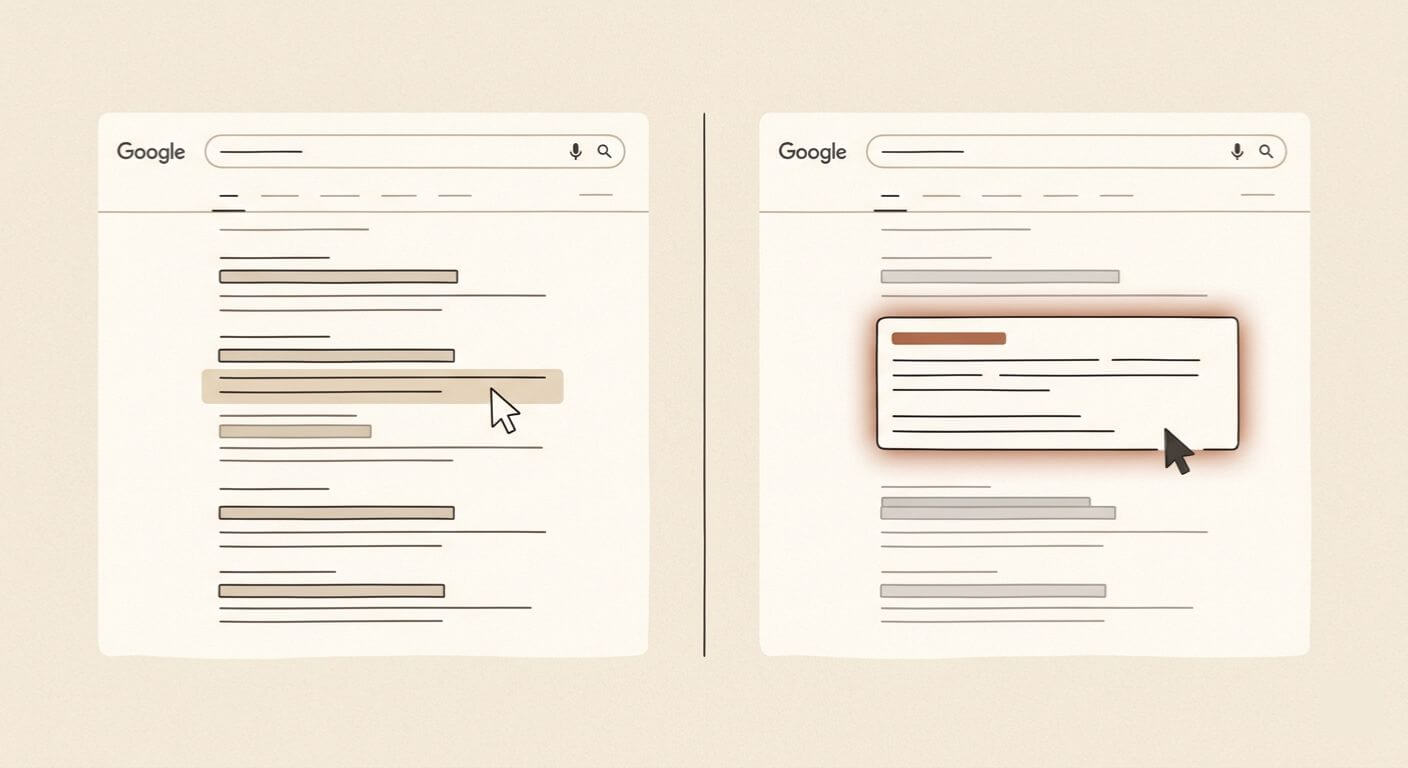
Click dependency vs impression dominance.

Click dependency means your value depends on the user leaving the search results page and arriving on your site. Impression dominance means your value comes from being repeatedly seen, cited, summarized, or selected as the source that resolves the query, even if the user never clicks through.
That is the deeper story behind zero click search trends; they are exposing which publishers were actually driving demand and which were only buffering uncertainty.
The Wrong Question Behind Zero Click Search Trends
The common reaction to zero click search trends is defensiveness. You get asked why traffic is down or why featured snippets and AI summaries are “stealing” demand.
That language assumes the click was the main economic unit, but zero click search trends make it clear that value is often moving earlier in the interaction.
A lot of SEO traffic was never high-intent in the first place. It was provisional traffic. Users clicked because they needed one more confirmation, one more source to feel safe. The content was not creating demand.
Users do not need to browse five mediocre pages if the answer is obvious enough on the results page. The click disappears because the system has reduced the number of steps between confusion and resolution.
Zero click search trends can feel harsher than they are. But what they do well is they remove the illusion that all traffic was meaningful.
Field Test: In Google Search Console, filter a top page and scan its queries. Google the top 3 and see if the SERP already resolves the intent before clicking.
Zero Click Is Not The End Of Value
For years, SEO strategy was built around bringing in more clicks and more conversions. While still somewhat relevant, that formula no longer captures the full picture.
Search engines now perform more of the interpretive work that once happened on publisher sites. They extract and sometimes answer directly. Value can now accumulate before the click, at the point of visibility itself.
It can be easy to miss because visibility is harder to measure than traffic. Traffic is concrete, it appears in analytics and dashboards. Visibility is softer. It is distributed across impressions, branded recall, answer inclusion, and repeated exposure.

But in practice, visibility is often the first stage of trust.
A user may see your answer three times across different queries before they ever click. They may not remember the sessions, but they remember the source. How can that be a weaker form of value? It is often a stronger one because it shapes preference before the user enters your site.
Search has moved from a click economy to a recognition economy.
Recognition economy rewards the sources that become familiar and repeatedly useful across many small moments. The click may still happen later, but it is no longer the only proof that influence occurred.
If this is speaking to you, I’ll send the next one when it’s ready.
“If users don’t click, did the content fail?”
Not necessarily. In some cases, a non-click is the clearest sign that the content succeeded.
That sounds counterintuitive only if the site visit is treated as the objective. But the actual objective was never the visit. The real objective was to resolve a need. If the search result or AI answer resolved that need directly, the interaction ended earlier.
From a user perspective, that is efficiency.
From a publisher perspective, it can feel like loss.
Both things can be true. The user may have won instantly while your analytics recorded no session. Your measurement system is incomplete. It can see the click, but not the absence of unnecessary effort. It can count the visit, but not the avoided browse.
This is why zero click search trends create so much confusion inside teams. Traditional analytics are built to measure downstream behavior after the click. They are not yet built to measure the moment a user decides they already have enough.
A non-click can mean several things. It can mean the content was irrelevant. It can also mean the content was so effective that it collapsed the need for further exploration. Those are very different outcomes, but the data often looks similar.
The challenge is to stop treating every lost click as a lost opportunity. Some of those clicks were never opportunities in the strategic sense. They were merely intermediate steps on the way to an answer.
Reality Check: Scan queries in Search Console where you rank top 3 but CTR is low. Separate likely “missed intent” from “intent already satisfied” cases.
The Better Your Answer, The Less Reason There Is To Send Traffic
The paradox sitting at the center of zero click search trends.
Search engines are designed to reduce uncertainty. If they trust a source enough to extract from it or place it in an answer layer, they are effectively delegating authority to that source. But they are also reducing the need for the user to leave the SERP.
So the stronger the answer, the weaker the incentive to click.
The old SEO bargain was that if you provide the answer, you receive the visit.
The new bargain is more unstable. Provide the answer, and the search engine may keep the user while still crediting you indirectly through citation or implied authority.

Google is not always suppressing your usefulness, sometimes it is using it. The system increasingly extracts from sources it trusts, then resolves the query itself. The publisher may gain authority while losing the session. The value migrates upward into the answer layer.
It can be a difficult switch to accept for teams trained on traffic reports, but it is essential if you want a realistic model of modern search.
Impression Dominance Versus Click Dependency
The most useful way to think about zero click search trends is through the difference between impression dominance and click dependency.
Click dependency is the old model in which your page must win the click to matter. If the user does not arrive, the system treats the interaction as invisible.
Impression dominance is the emerging model. Your content is valuable because it appears or is repeatedly associated with answers across query variants. The user may never visit, but the content still shapes the search experience.
Click dependency assumes value is realized after arrival while impression dominance assumes value is realized at the moment of recognition.
A high-click page with weak authority may look healthy in analytics but be strategically fragile. A lower-click page that repeatedly appears in answer spaces may be on its way to build durable influence.
“Traffic up” is not enough anymore. Traffic can grow while authority stagnates, and authority can grow while traffic falls. The second pattern may be the more valuable one, depending on the query class.
The job is to know which game each page is playing.
Field Test: Pick one low-CTR, high-impression query in Google Search Console and search it manually. Do you appear in snippets, PAA, or just blue links?
Which Queries Deserve A Click And Which Get Resolved Directly?
Not all search queries behave the same way. Some are naturally compressible and others resist simplification.
A stable, low-ambiguity query often does not need a click. If the answer is short and not context-dependent, the search engine has a strong incentive to resolve it directly. These are the conditions under which zero click search trends are strongest.
By contrast, queries with nuance or strategic ambiguity usually still need exploration. A user comparing products or making a high-stakes purchase often needs multiple sources, not one compressed answer. In those cases, the click remains valuable because the search engine cannot safely collapse the full decision.

A resolvable query can be answered cleanly enough that the search engine can compress it without losing much utility.
A debatable query cannot. It requires judgment or context that exceeds the answer box.
Why Impressions Are Increasing But Clicks Are Dropping In SEO
Many teams see rising impressions and flat or falling CTR and assume there is a problem, which is why they start asking why impressions are increasing but clicks are dropping. Sometimes there is, but often the pattern means something more interesting, which that the content is being promoted into the answer layer.
That can happen when a page begins to appear for more query variants or adjacent intents. It may also happen when the search engine starts treating your content as a reference source rather than just a destination page.
A standard ranked listing competes for attention. An answer-layer presence competes for definition.
It’s especially visible when multiple related queries trigger your content but not all of them lead to clicks. The user may be learning from your material in the SERP itself. That should not be dismissed as failure. It is a sign that your content now carries search-visible authority.
The analytical mistake is to treat CTR as the only meaningful signal. CTR matters, but it is only one stage in the chain. If visibility is increasing across high-value query sets, a lower CTR may simply mean the answer is being delivered earlier.
Field Test: Pull a 3-month query report and group keywords by intent. Are you gaining impressions on “what/why/how” searches that typically resolve on the SERP?
How Google Decides What Gets Resolved On The SERP
Search engines do not collapse every query, which helps explain why Google answers search queries without clicks in some cases and not others. They choose where to preserve exploration and where to reduce it.
A query is more likely to be answered directly when the answer is stable and low risk. The system can compress that into a short result without harming the user much. In those cases, zero click search trends are the intended design.
A query is more likely to keep the click when the answer is complex or sensitive. If the user needs comparison, nuance, or source diversity, the search engine has less confidence in a single compressed answer and it preserves the path to exploration.
The same topic can produce different search behavior depending on the phrasing and stakes involved.

For example, a query like “what is X” may resolve directly. But “best X for my team,” “X vs Y,” or “X under these conditions” often requires the click because the answer depends on context. The engine knows that compressing uncertainty too aggressively would reduce utility.
When Losing Clicks Is Actually A Sign Of Authority
One of the hardest ideas for SEO teams to accept is that fewer clicks can sometimes indicate more authority.
It may sound backward until you separate visibility from conversion. If your source is consistently used to answer a question, it may be because the search engine trusts it enough to quote or summarize it. Trust is not the same as traffic, but it is strategically valuable.
In that sense, click loss can be misread as decline when it is actually evidence of delegation.
The search engine is doing what editors once did in traditional media when selecting a source. They did it because it was useful and reliable enough to represent the topic. The user may not visit, but the source still shapes the public answer.
The objective is to make your brand part of search’s internal answer structure.
How? Build familiarity and reinforce topical ownership to influence later branded searches or direct visits. The click may disappear, but the brand effect can persist.
Reality Check: In Google Analytics 4, check branded vs non-branded traffic. Are branded searches increasing despite lower organic clicks?
How To Measure SEO In A Zero Click Environment
If clicks are no longer the only relevant outcome, then the measurement model must change too.
The first change, especially when thinking about how to measure SEO performance without clicks, is to stop treating sessions as the only proof of value. Session data captures what happened after the user arrived. It does not capture how often the content was used or selected to answer a question before arrival.
Measure by intent clusters rather than isolated pages. Pages are useful production units, but they are no longer always the right units of value. In a zero-click environment, query sets matter more than single URLs because search engines often assemble answers from multiple sources, not just one canonical landing page.
Additionally, track visibility quality, too, not only volume. A rise in impressions tied to high-value intents may be more meaningful than a rise in low-quality traffic.
Watch for signs that the content is being used outside your analytics boundary. If your material is being quoted or mirrored in a search result, knowledge panel, or AI-generated response, that is real performance. It may not appear in GA, but it can still influence future behavior.

The best measurement model in a zero-click world combines these layers:
- visibility at the query level
- authority at the topic level
- conversion at the downstream level
This gives you a fuller picture than traffic alone.
What To Track Instead Of Only CTR
CTR is still useful, but it is no longer sufficient.
A page with declining CTR may still be increasing in strategic value if it is gaining visibility in answer features or appearing across more related queries.
How often is your content appearing in featured snippets, AI summaries, knowledge-driven query boxes, People Also Ask sections, and other SERP elements that reduce the need for a click? Does your brand appear as the source or is it merely adjacent to the answer?
Also track whether this visibility is tied to commercially relevant intents. Some impressions are informational and far upstream, and others sit much closer to purchas or brand choice.
The best zero click strategy is to identify the exposures that shape future preference. A user may not click today, but they may remember your brand when they are ready to act.
Field Test: Pick one page and add a concise answer block near the top. Recheck in 2–3 weeks if it starts appearing in featured snippets or PAA.
Which Query Types To Optimize For Zero Click Outcomes
Not every query should be optimized for click capture. In fact, some should be optimized for zero click visibility on purpose.
The trust-building query category
These are queries where being the source of the answer builds authority, even if the user does not click immediately. These tend to be foundational informational topics, definitions, explanations, and frameworks that establish expertise. The value lies in being seen as the reference.
The preference-shaping query category
These are comparisons, best-of queries where the user is still forming judgment. A visible answer here can shape brand preference even if it does not deliver an immediate visit.
The support query category
These are usage or troubleshooting questions where the user needs a fast answer. If your content resolves the issue directly, that may reduce clicks but increase satisfaction and reduce friction. For products or services, that can strengthen retention and brand perception.

The queries to avoid over-optimizing for zero click are those that absorb attention without leaving any imprint. Some queries may be answerable directly but strategically irrelevant. If the user gets what they need and does not remember you, the exposure may not be worth much.
So the rule is to optimize for whichever outcome changes future preference.
Invisible Value With No Brand Imprint
Zero click visibility is not automatically good. It only becomes valuable when it creates some durable effect.
You may celebrate answer-box presence while ignoring the fact that the content leaves no impression. The user gets the answer, but the brand disappears. That is invisible value.
Invisible value is dangerous because it looks like influence but does not create preference or downstream demand. The content served the query, but it did not serve the business.
Some answers are too terminal. They close the interaction without creating a brand association. In those cases, the exposure may be strategically weak even if it is technically visible.
A better target is answer-layer visibility that opens a larger intellectual path. The answer should resolve the first question and create the next one. That next question is where the click becomes meaningful again.
This is one of the most important design principles in a zero click environment: clarity should create trust without finality, so the user keeps engaging. If your answer is so complete that nothing remains to explore, you may win the search moment but lose the business relationship.
Field Test: Pick one page that appears in a featured snippet and try searching its main query. Note whether your brand is visible or completely absent in the answer.
How To Structure Content For Impression Dominance Without Sacrificing Conversions
The best modern content does not try to fight the answer layer, and learning how to optimize content for zero click search results is part of that shift, it uses it.
The page or content asset should be structured so that the most extractable part is also the most useful top layer. Make the first answer clear and accurate. If search engines quote it, that is fine. But that answer should create curiosity, not closure.
You do this in practice by writing in layers.
The first layer should be concise enough to satisfy the basic query.
The second layer should add nuance, tradeoffs, exceptions, or decision rules.
The third layer should move into examples and applications that require more than a snippet can hold.

Search engines often extract the clearest 40 words. Those 40 words should not flatten the topic into a dead end. They should establish the core idea and make the reader want the missing context.
You can benefit from impression dominance without giving away the entire conversion path, by sequencing information.
Clarity earns attention and depth earns trust. The page should do both.
What Average Users Should Understand About Search Now
For non-experts, the simplest way to understand zero click search trends is this:
Search engines are trying to answer more questions directly.
That means some of the work once done by websites now happens inside the search interface itself. Users often get what they need faster. Publishers often get fewer clicks, but that’s for a later discussion.
The mistake is to think that fewer visits automatically mean less influence. In many cases, the content is still shaping the outcome, but it is just doing so earlier in the journey.
The old habit of judging content only by views is misleading. A useful page may now be the one that resolves a question without friction and establishes itself as the source search engines draw from.
Field Test: Pick a question your audience frequently asks and type it into Google. Note which results answer it instantly versus which link to your site.
How To Think About Zero Click Search Trends
There are three questions worth asking for every important topic.
First, is the query compressible?
If yes, expect the search engine to answer more directly.
Second, does the answer create brand memory or only close the session?
If it creates memory, the no-click may still be valuable.
Third, what is the downstream role of the content?
Some pages should drive visits. Some should build trust. Some should reduce friction. Trying to force every page into the same role leads to bad strategy.

Avoid optimizing every page for the same metric (a very common optimization mistake). That is inefficient in a search environment where different query types behave differently.
The better approach is to design a content portfolio.
What This Means For SEO Strategy
SEO used to be understood primarily as a traffic acquisition discipline. That view is too narrow now.
SEO is a visibility and authority discipline with traffic as one possible outcome. In many cases, the highest-value result is not the visit itself, but becoming the source that resolves the user’s uncertainty.
That does not mean traffic is irrelevant, but it does explain why impressions are increasing but clicks are dropping in many cases. It means traffic is downstream from a larger process. If the content is visible and repeatedly selected in answer environments, the traffic often follows later in more valuable forms, like branded search, direct navigation, assisted conversion, or offline preference.
The strategic goal is to maximize relevance at the point where the user forms judgment.
Zero click search trends should not be read as the death of SEO. They should be read as a correction to a narrow measurement culture. Search still rewards useful content. It just does so in more places than the click.
Field Test: Pick a recently published page and check how many internal links point to it. More relevance signals can improve its visibility in answer surfaces.
The Click Was Never The Goal
The most useful way to think about zero click search trends is to stop treating the click as the final proof of value.
The click was always a proxy. It stood in for attention and unresolved need. As search becomes better at resolving those needs directly, the proxy becomes less reliable.
In many cases, the value moved into visibility and early-stage recognition. In some cases, it moved into the answer layer itself. In others, it simply vanished because the content was never strategically essential to begin with. It’s the uncomfortable but useful lesson of zero click search trends. They show which pages mattered.
The pages that still influence the user when the click disappears are the ones that now define the search experience. The rest were only there to delay uncertainty.
And once answers get faster, delay is no longer a business model.