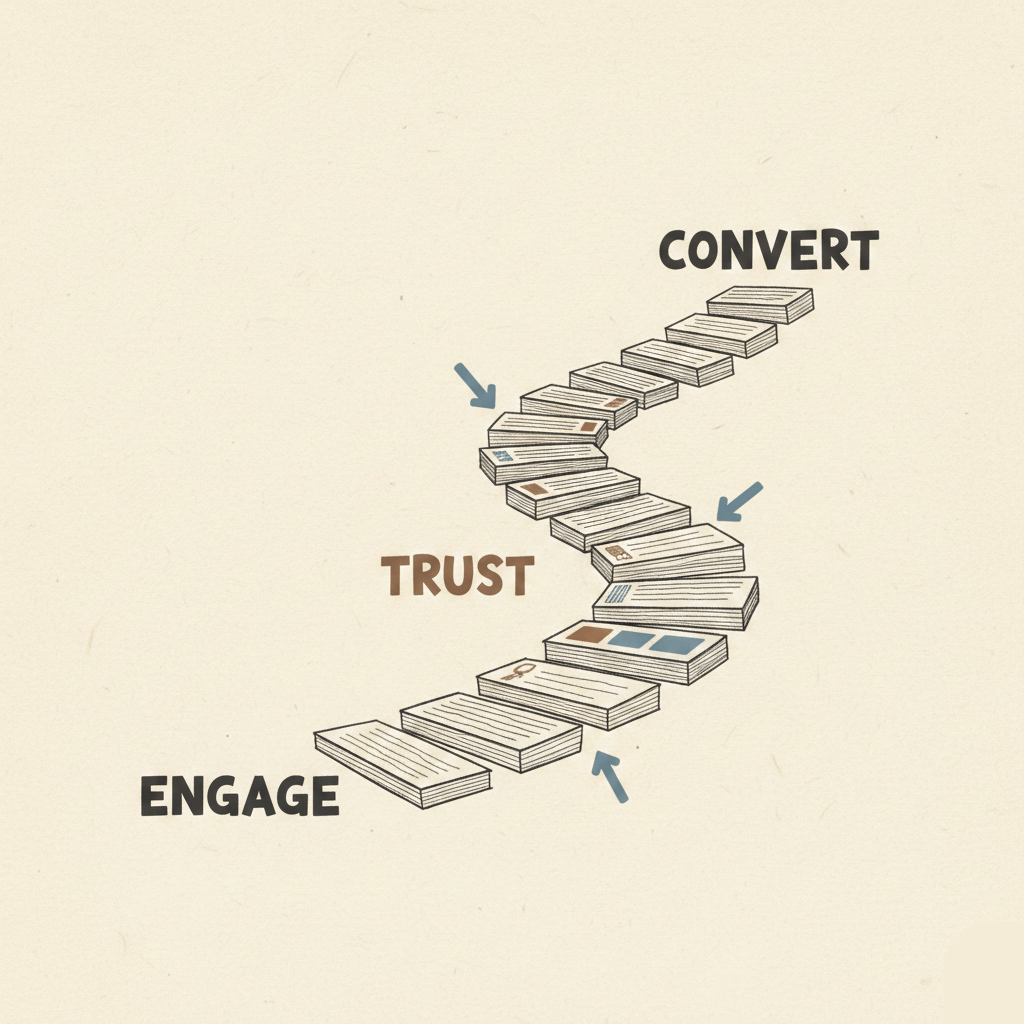
What Is the Best Length for a Blog Post and Why It Matters
The optimal blog length is not a single word-count prescription but a function of funnel stage, content type, and the behavioral outcome you’re optimizing for (browsing depth vs. direct conversion).
Length matters chiefly because it interacts with readability, topic fit, and internal linking to produce engagement signals that predict downstream conversion.
The best blog length is contextual. You choose length to maximize behavioral outcomes appropriate to the funnel stage, not to hit arbitrary word-count norms.
How the Best Blog Length Shapes Reader Behavior and Conversions
The primary objective of content marketing is to change user behavior in ways that indicate progress down the funnel (e.g., repeat visits, newsletter signups, product exploration).
Multi-post browsing and sustained session duration (e.g., ≥2 minutes and >1 blog page per session) are stronger proximate indicators of future commitment (subscription or repeat visits) than single-page dwell time alone.
Post length influences these indicators only indirectly, through topical comprehensiveness, readability, and structural affordances like CTAs and interlinking. In this sense, the best blog length is the one that enables these qualities most effectively, rather than an isolated metric of success.
Consequently, the “best” length is the length that, given a funnel stage and content type, optimally balances topical completeness, cognitive load, and navigational affordances to produce the target behavior (browse depth or conversion).
For additional context on how content length and structure influence engagement, see this study on time-on-site and user behavior.
Mapping the Best Blog Length by Funnel Stage (TOFU, MOFU, BOFU)

Best Blog Length for Awareness: Short, Clickable Posts That Build Interest
→ Objective: attract and encourage exploration.
- behavioral priority: increase browsing depth (pages/session), low barrier to entry.
- recommendation: short, scannable posts (bite-sized answers, 300–700 words) with prominent internal links to related topics and an easy subscription CTA.
Short posts reduce attention friction and invite clicking on related posts; if too long, readers may bounce after partial reading and fail to discover additional content. For example, pairing short posts with insights on AI-powered search strategies helps surface relevant content faster.
Best Blog Length for SEO and Engagement in the Consideration Stage
→ Objective: develop trust and curiosity.
- behavioral priority: longer dwell time, content that answers deeper questions and primes further site exploration.
- recommendation: medium posts (1,000–1,800 words) that provide nuanced answers, include helpful visuals/summaries and link to both TOFU and BOFU resources.
This length supports depth without overwhelming a curious user. Incorporating Google SERP optimization tips can guide structure for higher visibility and engagement.
Best Blog Length for Conversions: When Long-Form Content Wins
→ Objective: justify action.
- behavioral priority: authority and decision support (conversions rather than browsing).
- recommendation: long-form, evidence-driven content (2,000+ words), gated resources, and conversion-focused CTAs.
Longer content signals expertise and answers objections. See conversion-focused SEO content for practical examples of structuring long posts to drive leads effectively.
Why Blog Length Alone Doesn’t Guarantee SEO or Engagement
- Mechanism: Length → (completeness, examples, citations, nuance) → perceived value/trust → user action.
- When posts are too short for the task: they fail to resolve user questions, increasing bounce or forcing users to search elsewhere (low retention).
- When posts are too long for the task: cognitive fatigue, lower scanability, and fewer click cues reduce exploration (low pages/session) unless the long post is well-structured and skimmable.
*Key moderating variables: readability (Flesch/SMOG), structural signals (subheads, bullets), topic familiarity, mobile vs desktop, and quality of interlinking. All factors that determine what the best blog length is for a given scenario.
How the Best Length for a Blog Post Changes by Content Type
- Evergreen guides: tend to benefit from longer, more comprehensive formats because they’re used as reference. Interlink aggressively to create pathways (primer → deep dive → case study).
- Timely news / opinion: shorter, faster posts fit editorial cadence and encourage quick shares; deep analysis can be follow-up longform.
- How to map type → metric: for evergreen, optimize for organic SEO and long-run sessions/repeat visits; for timely pieces, optimize for immediate social clicks and share-driven referral.
Does the Best Blog Length Actually Drive Engagement or Just Correlate?

Observationally, you see length correlated with outcomes, but causality is mediated. The causal chain should be framed as:
Length + structure + topical fit + interlinking → richer session behavior (time on site, pages/session, micro-conversions) → higher likelihood of subscription/conversion.
- Important note: quality, author reputation, and distribution channels often confound the relationship.
How to Test What the Best Blog Length Is: Metrics and Experiments
- Define outcome metrics (primary & secondary):
- Primary (behavioral): pages/session (blog pages), average time-on-site per session, event: newsletter signup, product demo request.
- Secondary: scroll depth, CTR on internal links, bounce rate, returning visitors within 30 days.
- Primary (behavioral): pages/session (blog pages), average time-on-site per session, event: newsletter signup, product demo request.
*Composite success KPI example: Session_success = (time_on_site >= 120s AND pages_per_session >= 1.5) OR newsletter_signup.
The best blog length should support these metrics by enabling users to engage meaningfully without cognitive overload or frustration. Experimenting with SEO reporting and snippet tracking is a powerful way to measure which post lengths drive attention and micro-conversions.
To put testing in context, you can also review how long it typically takes for a page to rank on Google. It helps set expectations for measuring engagement and SEO outcomes.
- Form hypotheses (examples):
- H1 (TOFU): Short posts with 3–5 internal links will yield higher pages/session than long single-topic posts.
- H2 (MOFU): Medium-length posts with embedded next-step CTAs will increase conversions to gated content vs. short posts.
- H3 (BOFU): Long evidence-based posts increase per-session conversion rate but reduce pages/session.
- H1 (TOFU): Short posts with 3–5 internal links will yield higher pages/session than long single-topic posts.
- Experiment design (A/B or multivariate):
- Randomly assign visitors (or traffic segments) to variants of the same topic rendered in short, medium, and long formats to hold topical interest constant.
- Keep author, distribution source, and headline constant where possible. Use the same internal linking strategy across variants if testing length only, or manipulate linking separately to test interaction effects.
- Randomly assign visitors (or traffic segments) to variants of the same topic rendered in short, medium, and long formats to hold topical interest constant.
Run long enough to accumulate sufficient conversions; precompute needed sample size for conversion metric using baseline conversion rate.
- Statistical tests & controls:
- Use logistic regression (conversion ~ length_category + pages_session + time_on_site + device + referral_source).
- Use survival analysis or time-to-event for time-on-site differences.
- Use logistic regression (conversion ~ length_category + pages_session + time_on_site + device + referral_source).
Control for seasonality and traffic source.
- Qualitative follow-up:
- Heatmaps and session recordings to see whether long posts reduce visible click cues.
- Micro-surveys (“Was this article useful?”) to assess perceived completeness vs. friction.
- Heatmaps and session recordings to see whether long posts reduce visible click cues.
Best Blog Length Playbook: Quick Actions to Optimize Post Performance
- For new topics: publish a short TOFU primer + a linked medium MOFU article and a long BOFU guide. Measure which path drives the most subscriptions.
- For high-traffic evergreen pages: expand with linked subpages rather than adding a single very long page. Create a “cluster” with a pillar page and linked deep dives.
- Always optimize structure before length: improve headings, add TL;DRs, bullets, strong internal links, and clear CTAs. These typically produce more lift than increasing raw word count.
The “best” blog length is an instrument. Choose length to achieve a specific behavioral objective (browse depth vs. conversion) at a given funnel stage, and validate with controlled experiments that isolate length from quality, readability, and interlinking.
In practice, structure and topic fit often dominate raw word count and length only helps when it’s the most efficient way to deliver clarity and evidence.
Balancing Templates and Adaptation to Find the Best Blog Length per Funnel
Scalable content operations require standardization, but over-standardization erodes the contextual precision that makes content effective by funnel stage. Stick to templatizing what benefits from uniformity, and dynamically adapt what depends on behavioral or contextual variables.
The Principles Behind Choosing the Best Word Length for Blog Posts
Standardization reduces cognitive and operational load. Templates enforce consistency in tone, structure, and metadata, which improves brand coherence and production speed.
Not all parameters are static. Variables like optimal length, content density, and tone depend on situational inputs (topic complexity, audience intent, funnel stage). Fixed templates can misfire when they ignore these dynamics, including what constitutes the best blog length for a particular post.
Therefore, content production should operate as a two-layer system:
- Static layer (templatizable): predictable, repeatable components that form the backbone of production.
- Adaptive layer (dynamic): context-sensitive parameters that adjust through data feedback or human/AI judgment.
Standardizing Blog Structure Without Fixing the Best Blog Length
→ elements that benefit from uniformity (ensuring both quality control and efficiency):
| Category | Purpose | Implementation |
| Headline Frameworks | Reinforce recognizable logic (e.g., “How to…”, “X Reasons Why…”, “Data Shows…”) | Maintain a shared library of headline formulas tagged by funnel stage. |
| Intro Formula | Establish rhythm and predictability | Hook → Context → Value Promise → CTA for continued reading |
| Internal Linking Logic | Encourage deeper site navigation | Minimum 2 internal links: one lateral (same stage), one forward (next stage) |
| CTA Positioning | Standardize conversion cues | Newsletter CTA at ~75% scroll depth; contextual CTA at end. |
| Metadata + Formatting | Support SEO and brand coherence | Fixed structure for H2/H3s, image ratios, schema tagging. |
| Tone Guidelines | Maintain brand voice | Use tone parameters per funnel stage (Friendly / Balanced / Authoritative). |
| Funnel Tagging Schema | Enable automation and analytics | Each post assigned TOFU, MOFU, or BOFU at brief stage. |
All of the above can live inside a content brief generator (ChatGPT or CMS plugin) that pre-populates the structure.
Adaptive Content: Adjusting Blog Length Based on Real Engagement Data

→ elements that must flex according to performance data or user intent signals:
| Dynamic Variable | Description | Adaptive Mechanism |
| Length & Depth | Adjust word count to engagement trends per topic. | AI model recommends range (e.g., “Expand by 400 words to reduce bounce”). |
| Content Density | Balance readability vs. authority. | Readability score monitoring; adaptive rewriting prompts. |
| User Intent Nuance | Tailor approach to awareness level (problem vs. solution aware). | AI brief prompt includes intent flag (“solution-aware reader”). |
| Inter-post Sequencing | Optimize next-step recommendation. | CMS plugin or AI suggestion based on recent behavior metrics. |
| Tone Variation | Modify register across funnel. | TOFU = approachable; BOFU = authoritative. Guided via prompt variable. |
This layer depends on adaptive workflows: human editors + AI tools analyzing metrics such as scroll depth, session duration, and CTR to internal links.
How to Measure the Best Blog Length in Practice
- Strategic Planning (Human-Led)
- Define quarterly content themes aligned with funnel goals.
- Assign funnel tags (TOFU/MOFU/BOFU) and target KPIs (e.g., pages/session or conversion rate).
- Define quarterly content themes aligned with funnel goals.
- Brief Generation (AI-Assisted)
- Human inputs: topic, funnel tag, keyword intent.
- AI generates: outline + structural template (headline, intro, link map, CTA placement).
- Human inputs: topic, funnel tag, keyword intent.
- Draft Creation (AI First Pass)
- AI produces initial 60–70% draft based on the template and prompt parameters (e.g., “TOFU post, 900 words, friendly tone, goal: encourage further browsing”).
- AI produces initial 60–70% draft based on the template and prompt parameters (e.g., “TOFU post, 900 words, friendly tone, goal: encourage further browsing”).
- Editorial Adaptation (Human Refinement)
- Editor adjusts tone, ensures factual accuracy, integrates data or original insight.
- Adjusts adaptive variables: trims or expands length, strengthens interlinking.
- Editor adjusts tone, ensures factual accuracy, integrates data or original insight.
- Publication & Instrumentation
- Post goes live with behavioral tracking (scroll depth, time-on-site, CTA clicks).
- Post goes live with behavioral tracking (scroll depth, time-on-site, CTA clicks).
- Performance Feedback Loop (AI-Assisted Analysis)
- Analytics dashboard aggregates behavioral data by funnel stage.
- AI suggests updates: “Shorten intro to reduce bounce” or “Add internal links to X”.
- Analytics dashboard aggregates behavioral data by funnel stage.
- Template Calibration (Monthly)
- Human content lead reviews aggregate data.
- Adjusts “default” length ranges or readability standards by stage.
- Human content lead reviews aggregate data.
Templates safeguard quality and speed. Adaptive logic preserves strategic precision.
AI should serve as the conditional layer that interprets data signals and adjusts execution parameters, including the best blog length, rather than replacing human editorial judgment.
Blog Templates and Prompts to Hit the Best Blog Length by Funnel Stage
TOFU Template: Best Blog Length and Structure for Discovery Content
Objective: Spark discovery; encourage browsing.
Layout:
- Headline: Problem-oriented or curiosity-driven (“Why [Pain Point] Keeps Costing You Customers”)
- Intro:
- Hook (1–2 sentences of tension or question)
- Context (brief situational framing)
- Promise (what they’ll learn in 3–4 minutes)
- Hook (1–2 sentences of tension or question)
- Body (3 short sections):
- Section 1: Define the problem clearly.
- Section 2: Give 2–3 actionable takeaways.
- Section 3: Link to related posts for deeper exploration.
- Section 1: Define the problem clearly.
- CTA: “Explore next” link + newsletter prompt.
- Length Target: 600–900 words.
AI Prompt Inspo:
Write a 900-word TOFU blog post for readers who are problem-aware but not yet solution-aware. Use a friendly, clear tone. Follow the structure: Hook → Context → Promise → 3 short actionable sections → CTA to explore related posts. Include at least 2 internal links to related beginner-friendly content.
MOFU Template: Best Length for Blog Posts That Build Trust
Objective: Deepen engagement; nurture trust.
Layout:
- Headline: Data-backed or expertise-led (“3 Research-Backed Tactics for Reducing Customer Churn”)
- Intro:
- Hook (statistic or insight)
- Context (why it matters now)
- Promise (depth and next steps)
- Hook (statistic or insight)
- Body (3–4 medium-length sections):
- Explain core concepts with moderate depth.
- Embed examples or visuals.
- Include links to both TOFU and BOFU posts.
- Explain core concepts with moderate depth.
- CTA: Invite newsletter signup or content download.
- Length Target: 1,200–1,800 words.
AI Prompt Inspo:
Write a 1,500-word MOFU blog post for readers who understand the problem and are evaluating approaches. Use a balanced, data-informed tone. Include 3–4 sections with subheadings, practical examples, and a concluding CTA inviting newsletter signup or resource download.
BOFU Template: Best Blog Length for Conversion-Focused Posts
Objective: Drive conversion; reinforce authority.
Layout:
- Headline: Outcome- or decision-oriented (“How [Your Product] Solves [X Problem] with Proven ROI”)
- Intro:
- Establish authority (credential or data point).
- Frame the pain in decision terms.
- Promise evidence and resolution.
- Establish authority (credential or data point).
- Body (3–5 sections):
- Deep analysis, data, or case study.
- Explicit contrast with alternatives.
- Address objections or FAQs.
- CTA: direct conversion (demo, contact, purchase).
- Deep analysis, data, or case study.
- Length Target: 2,000–2,500 words.
AI Prompt:
Write a 2,000-word BOFU blog post for readers who are evaluating solutions and ready to decide. Use an authoritative, confident tone. Include data, case study examples, and a clear CTA inviting a demo or consultation. Maintain factual credibility and readability.
***Dynamic Prompt Layer: Auto-Optimizing the Best Blog Length per Post
Add this conditional clause at the end of any AI prompt:
Adjust target length and tone based on engagement metrics from similar posts:
- If average time-on-site < 90s, shorten by 15%.
- If scroll depth > 70%, maintain or expand by 10%.
Suggest structure changes to improve browsing depth.
The question of the best blog length reveals less about word counts than about how readers think, move, and decide. The most effective creators are designing experiences that fit how audiences seek understanding at each stage of intent.
What matters is how clearly that structure supports discovery, trust, and eventual action because visibility today isn’t won by volume, but by resonance that endures beyond the scroll.
Leave a Reply