
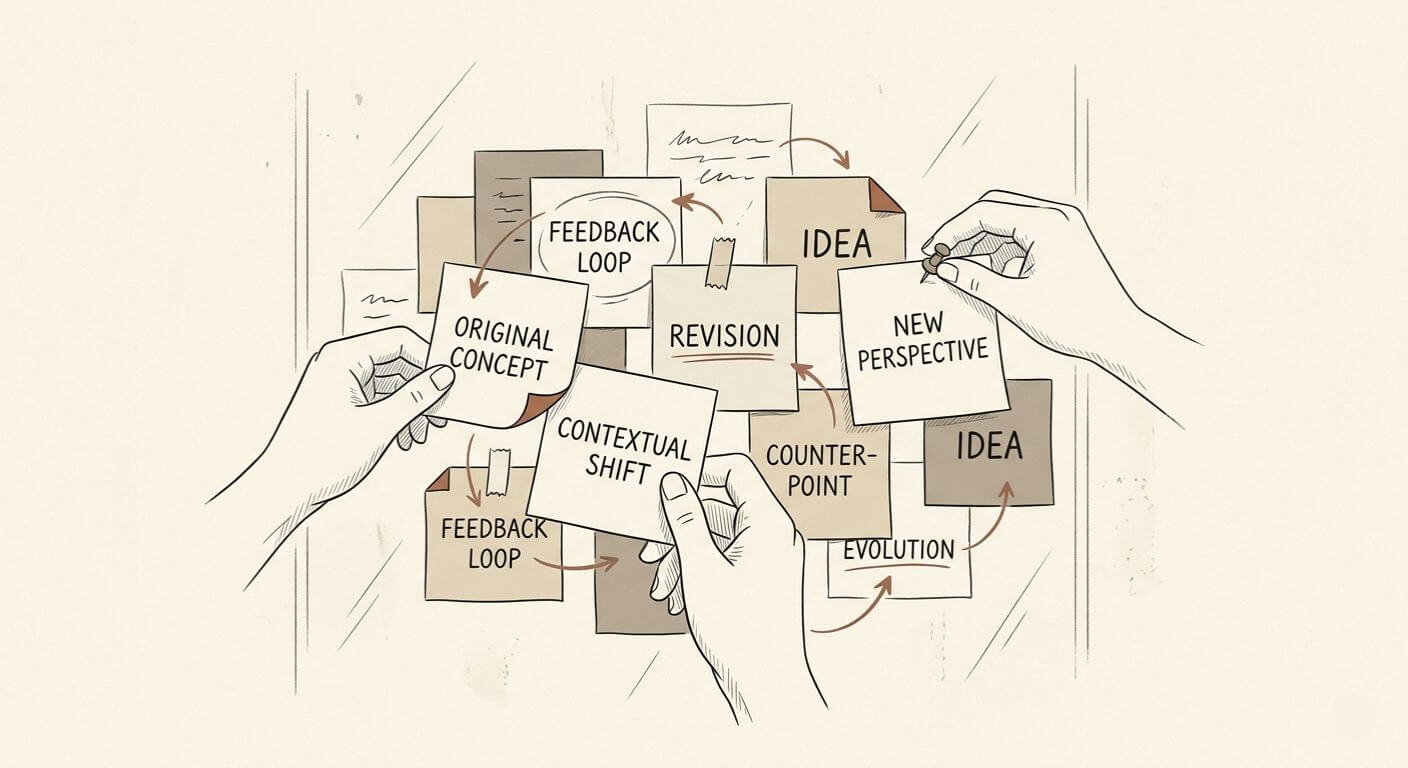
You can spend a long time believing you are building something for a community when, in practice, you are mostly building a sculpture of your own assumptions and calling it public-facing.
A lot of building with community feedback begins with realizing how much of the work was never actually in conversation with the people it claimed to serve.
Usually it begins more innocently. You have a sense of who the work is for, a little model in your head of their taste, their pain, their schedule, their language. You make something that seems generous. You point to it and say, more or less, this is for you.
Then the people you meant to serve look at it and do not see themselves. Or they see a version of themselves that feels too neat or too convenient. And that is the point at which you realize you have been worldbuilding alone.

You Are Not Building for a Community Until They Interrupt You
The strange thing is that many founders or builders in a community really do love communities. Just not always actual ones.
They love the atmosphere of participation, the flattering image of being surrounded by engaged people. They love a Slack channel in the abstract, an audience in the plural.
Proximity is where things get less romantic, and probably the first real lesson in how to build with community feedback instead of projecting needs onto strangers.
Proximity is where the work starts arguing back. A real person will misunderstand you, redirect you, ignore the thing you thought was essential, or ask for something that does not fit your roadmap.
A real person will inconvenience your assumptions. And oddly enough, that inconvenience is often the first honest sign that you are near the truth.
Over time, building with community feedback builds a different way of understanding authorship itself. It changes the moral temperature of the work. It reminds you that your first draft is nothing more than a proposal.
The best builders know this in their bones, even if they still get defensive when it becomes obvious. They understand that meaning does not survive intact when it moves from one mind to another. It has to be translated, and translation is never sterile. It adds texture. It loses some things. It reveals others you did not know were there.
If you cannot let other people carry the meaning of what you are making, then you may have made a thing that still lives entirely inside your own nervous system. That can look like leadership, it can even produce momentum, but it is a fragile arrangement. The company, the project—whatever you call it—remains psychologically one person.
A lot of what is described as “alignment” is really just dependence in a nicer jacket. If every important decision has to route through you, the work is crowded around a single founder bottleneck.
Your taste may be good and your instincts may be sharp, but none of that changes the fact that a mission that cannot survive translation is not much of a mission yet.
You notice this first in small ways. Someone on the team uses the product in a way you did not intend, and at first you feel the familiar little flicker of irritation.
Then, if you stay with it, you notice they have actually exposed something real; a use case, a need, a social dynamic, a gap in the language.
A customer says the feature you were proudest of is not what matters to them another repeats your own idea back to you in words you would never have chosen, and somehow their version is clearer. It’s all worth keeping.
If this is speaking to you, I’ll send the next one when it’s ready.
Building With Community Feedback as a Way of Distributing Meaning
The project usually grows the moment you stop requiring full ownership of every valuable insight. It can feel like a loss if you have been taught to treat originality as proof of worth.
But there is a difference between abandoning your discernment and refusing to hoard it. The work is not somehow less yours because other people helped shape it.
In some cases, it becomes legible for the first time. It becomes easier to carry because other hands have helped adjust the weight.
And it is at this point where community feedback turns into a way of finding out what the work actually wants to become. The phrasing can sound a little mystical, but it is usually just a recognition that good projects have behaviors of their own. They attract certain questions and create openings you did not foresee.
You can listen for that without pretending the project is autonomous, without slipping into a kind of faux destiny. You just have to be willing to hear the difference between what you meant and what arrived.
And what arrives is often more interesting than what you planned.
Communities introduce ideas you would never have arrived at alone because they are working with different constraints and different vocabularies of need.
They live closer to the mess than you do, which is one reason founders should listen to users before they start protecting their own interpretation of the product too aggressively.
They know what sounds good in a presentation and what survives a Tuesday afternoon. They know which part of your cleverness is actually useful and which part is mostly decorative. If you listen without an agenda, really without one, you get access to a kind of distributed intelligence. A field of partial truths that, taken together, can move the work somewhere you would not have chosen but probably needed.
When Does Feedback Actually Start to Change the Work?
Of course, listening without an agenda is harder than it sounds. You are never truly empty. You arrive with preferences, constraints, a budget, a deadline, a desire to be seen as responsive. There is always an agenda hiding somewhere in the room.
Still, you can notice when you are listening to confirm and when you are listening to learn. The first kind of listening is efficient but closed. The second is slower and a little humiliating. It asks you to endure the possibility that the best version of your work may not be the one you had in mind when you started.

You can build small structures that make room for real feedback instead of ceremonial feedback. You can ask better questions and fewer leading ones. You can read the support tickets, the comments, the offhand replies, the things people say when they do not think you are collecting them. You can stop only asking the loudest or most legible users what they think. You can notice who has been excluded from the conversation by your own convenience.
You can also be more careful about how you interpret the noise of the information environment around your work, especially if you are trying to practice something closer to community-led product development than top-down brand management.
With everyone talking at once and each platform trying to compress complexity into a posture, it is easy to confuse volume for wisdom. A trend is not necessarily a need. Know that not every sharp comment deserves a strategic pivot, but also that some of the most important truths arrive under the radar at first, from the people no algorithm promotes.
Save yourself from mistaking your own perspective for the whole picture, which is one of the oldest traps in any creative effort. You do not need to become impressionable. You do need to become reachable. There is a difference.
Community feedback teaches you to stay with uncertainty without collapsing into self-reference. It makes room for the fact that some of the best parts will arrive through people you did not predict, from places you had not optimized for, in language you would not have chosen. And as disorienting as it that can be, it can also be the beginning of something sturdier than individual taste.
Building alone has a way of shrinking the world until it looks like your own reflection. Once you notice that, it’s harder to unsee.

Rox Jibotean
Writer & Editor, Beyond Chit-Chat
I write about the space between what the digital shows us and what people are actually experiencing, and how things begin to reveal themselves when you learn to see both at once.
@rox.jibotean on IG →