
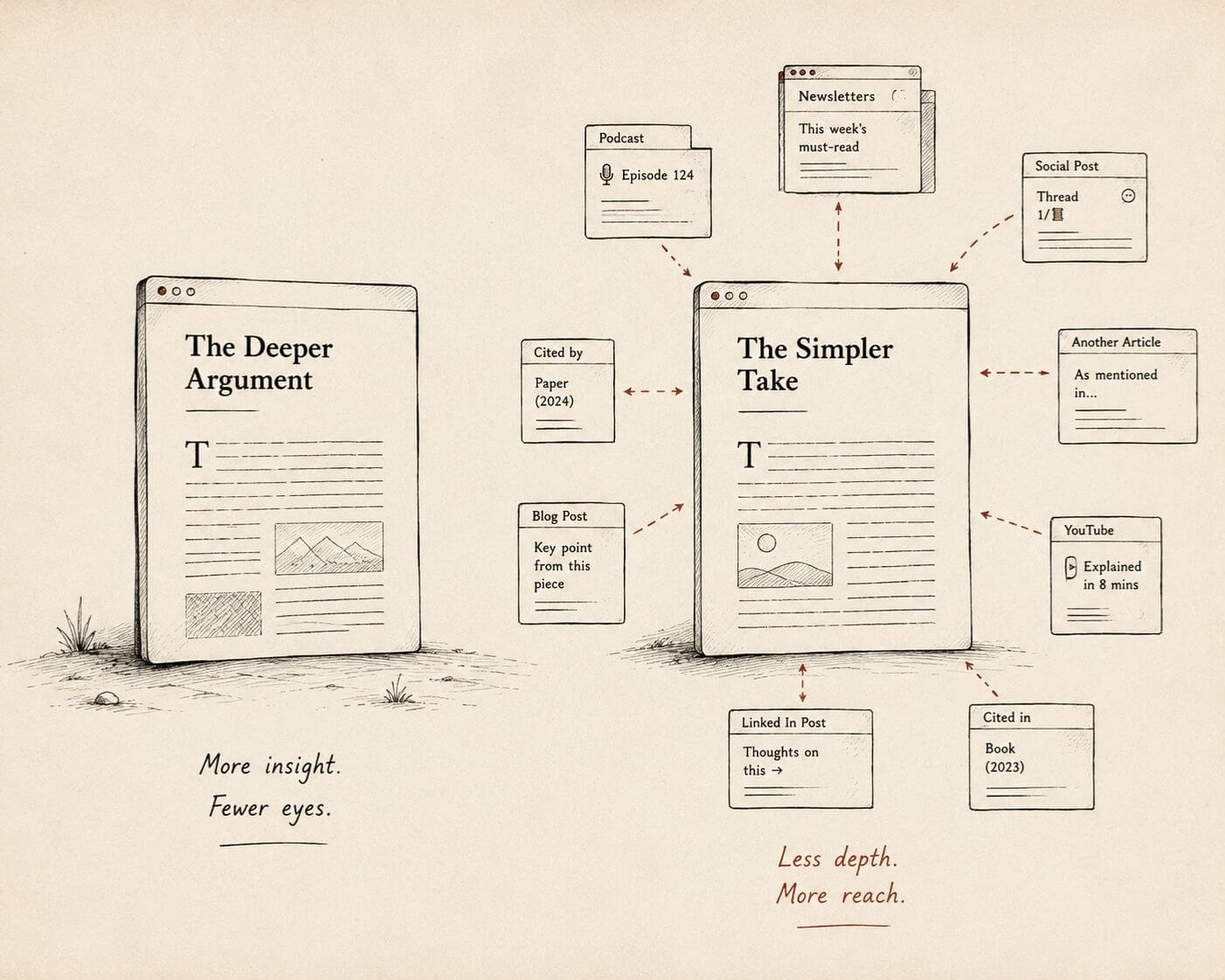
Search reputation signals begin with systems rewarding familiarity under uncertainty.
The old model of search rewarded relevance and optimization. But an additional layer is now shaping visibility and that is recognition under uncertainty.
When a search engine or AI system is unsure, it does not behave like a neutral judge with perfect memory, it behaves like a risk manager. It prefers sources that fit familiar patterns, sources that have already been socially validated across the web.
A page can be technically solid and still vanish from the answer layer if it is not repeatedly reinforced by the broader ecosystem. Meanwhile, a weaker page can keep reappearing because it has become a familiar object in the retrieval graph. In other words, search visibility is less like a one-time ranking event and more like a reputation system.
It’s how AI search visibility now behaves across AI-assisted search and multi-source answer synthesis.
For SEO professionals, content strategists, growth marketers, and technical writers, the unit of competition is moving from page quality to source recognition, and AI search visibility more and more depends on being remembered.
What Search Reputation Signals Are
Search reputation signals are any patterns that increase the probability that a search system will treat your site or content as a recurring trustworthy source rather than a one-off result.
- Traditional SEO asks whether a page matches a query and can compete in the ranking stack.
- Search reputation asks whether your source belongs in the system’s default mental map of the topic.
A source with strong search reputation can be built through:
- repeated topical association
- recurring citation patterns
- semantically consistent publishing
- multi-platform mention density
- query rewriting compatibility
- co-citation with other trusted sources
- stable interpretive framing over time
It’s why you see some websites keep surfacing even when their individual pages are not exceptional. The system has seen them before in the right contexts, so they are recognized.
If this is speaking to you, I’ll send the next one when it’s ready.
Why Search Systems Favor Familiar Sources Under Uncertainty
Search and AI retrieval systems operate under constraints:
- They must answer quickly.
- They must avoid obvious errors.
- They must make judgment calls from incomplete evidence.
Under those conditions, familiarity is key.
A system that has seen your domain associated with a topic many times is less likely to treat you as an unknown variable. That does not mean you are always ‘best.’ It means you are safe to recall, which is part of how Google choosing sources for AI answers can privilege familiar domains under uncertainty.
Good enough and repeatedly seen often beats best but isolated.
What search reputation is not
It is not just brand awareness.
It is not raw authority score.
It is not merely backlinks.
A brand can be widely known and still lack topical memory in search, a page can win by freshness once and then disappear because nothing around it reinforces the same identity.
Search reputation is narrower and more operational than brand equity, but broader and more distributed than page-level SEO.
Why Search Visibility Is Changing From Rankings to Recall
Traditional rankings measure placement at a point in time.
AI retrieval measures something closer to recall probability, how likely a source is to be retrieved or paraphrased across multiple rewritten versions of a query.
Search is no longer one query or one click path.
A user might ask the same intent in ten different ways:
- “best way to structure internal links for topical authority”
- “how to connect articles for SEO trust”
- “internal linking strategy for AI search”
- “how to make Google understand a content cluster”
- “what internal links help with semantic relevance”
If your content appears across several of those rewritten intents, you are building retrieval familiarity.
Note the difference between a page that wins one query and a source that keeps resurfacing across a topic.
How Ecosystem Reinforcement Shapes Search Visibility
Many publishers still assume visibility is a straightforward meritocracy. Better page, better rank. Better article, better outcome.
But the ecosystem rewards reinforcement.
When the same sources get cited repeatedly, not only do they just look authoritative, they also are easier for systems to justify, creating a loop:
- A source appears in one relevant place.
- It gets reinforced by mentions, citations, or links.
- It’s now easier to retrieve for adjacent queries.
- It gets surfaced again.
- The pattern strengthens.
And the result is not necessarily the objectively best source winning every time, but the most recognized source winning within the confidence budget of the system.
It’s why niche experts can have a strange split outcome:
- strong citation presence across AI systems or web mentions
- weak click visibility in the SERP
- high credibility in interpretation, low dominance in traffic
They are visible in the layer where systems synthesize answers, but not always where users still click most often. It’s already one of the defining troubles in modern SEO; being trusted as a source does not equal being rewarded with traffic.
Why Repeated Mentions Influence Search Visibility
Silence online looks like decay.
If your domain, experts, concepts, or frameworks stop appearing in the broader information ecosystem, the system has fewer reasons to treat you as a living source. You may still rank occasionally for exact matches or legacy pages. But you stop being part of the cluster of sources that retrieval systems reach for by default.
A source that is widely discussed and paraphrased continues to signal relevance. A source that goes quiet it’s easier to exclude, even if the content itself remains strong.
Reputation-based visibility is not something you can “set and forget.” It requires ongoing reinforcement.
Signs Google Recognizes Your Site as a Trusted Source
The strongest signal is multiple semantically adjacent pages gaining visibility together. It tells you the system is mapping your domain to a topical role.
Here are the patterns that matter most.
1) Multiple related pages surface for related intents
When several pages on your site gain impressions for different but semantically adjacent queries, that is a sign of topical recognition.
For example:
- one article on internal linking
- one on content clusters
If they all start receiving impressions across rewritten queries, the system is learning that your site is a relevant source for that conceptual territory.
2) Your content appears through query rewriting
If your content surfaces for many different formulations of the same problem, you are being associated with the underlying concept. It’s a stronger signal than ranking for one precise phrase.
3) Your brand appears across different content types
A source becomes more credible when it appears in:
- editorial articles
- podcast transcripts
- interviews
- guest posts
- citations in industry roundups
- community discussions
- industry documentation
- comparison pages
A cross-format recurrence makes your brand easier to retrieve simply because it creates pattern repetition.
4) Impressions broaden before rankings stabilize
Sometimes the first sign of reputation growth is more impressions across a wider set of long-tail queries. The system is testing your source in more contexts.
5) You become associated with a topic family
For example, you are not only “the source for internal linking.” You become associated with:
- crawl architecture
- topical authority
- semantic structure
- page relationships
- content hub design
Broader than keyword ownership.
How Co-Citations Strengthen Search Reputation Signals
AI systems infer credibility relationally. Who appears near you counts almost as much as what you say.
A co-citation is not just a backlink, but a contextual association. If your brand is repeatedly mentioned near the same trusted entities, the system learns that you belong in that interpretive neighborhood.
Over time, these associations create semantic gravity.
If your site is often discussed alongside:
- established industry research
- recognized practitioners
- authoritative documentation
- respected publications
- known frameworks
then retrieval systems start to treat your content as part of a stable cluster. It’s valuable to you because AI and search systems often prefer to answer with sources that fit existing relational patterns.
Why this is important for visibility
A site does not need to dominate a term directly if it is part of the conceptual cluster around that term. That cluster can surface you for:
- adjacent queries
- comparative queries
- problem-solving queries
- interpretation queries
- “best sources on X” prompts
Tons of brands dominate adjacent queries without owning the exact-match keywords.
How Query Rewriting Expands Visibility for Trusted Sources
Query rewriting and SEO visibility are now tied together because reputation-based source selection can surface the same source across many intent variants.
A user’s original query is often not the query the system ultimately uses.
The system may rewrite it into:
- a more general query
- a more specific query
- a comparative query
- a related conceptual query
- an intent-resolved version of the query
Each rewrite expands the number of opportunities for the system to justify showing the same familiar sources, which means the more abstract the user intent, the more valuable source reputation becomes.
Why this changes SEO strategy
In a purely keyword-driven world, the biggest challenge was alignment. However, in a query-rewritten world, the biggest challenge is being the source the system already trusts for the topic family.
It’s because of this that you see some pages with mediocre “keyword fit” still surface repeatedly:
- they match the broader intent
- they sit in a trusted source cluster
- they have been repeatedly reinforced
- they reduce hallucination risk
- they fit the system’s answer template
So the future of SEO is about being a reliable answer source across rewritten intent space.
How Cross-Platform Consistency Builds Retrieval Confidence
When the same ideas appear across your site, your social content, your interviews, your media mentions, your presentations, and your citations, then you’ve ensured repetition is machine-readable.
The system is in no impressed by your branding, but repeated conceptual patterns reduce ambiguity.
A search system is trying to answer:
- Who is this source?
- What do they stand for?
- Which topics do they reliably help explain?
The more consistent your conceptual footprint, the easier those questions are to resolve.
Examples of consistency
- using the same interpretive lens across articles
- repeating a defined point of view
- maintaining terminology across platforms
- reinforcing the same topical adjacency
- avoiding random topic drift in public content
Just to be clear, you shouldn’t sound repetitive. You should make your intellectual identity legible.
The strongest brands publish in a way that makes their thinking recognizable.
How to Tell the Difference Between Visibility and Ranking Luck
A lot of teams misread temporary ranking success as durable visibility.
The test is simple:
- Luck spikes vertically.
- Momentum spreads sideways.
If one page briefly ranks and then fades, that is usually a spike. But if multiple pages start appearing across adjacent queries, that is momentum.
Signs of momentum
- impressions expand into related long-tail queries
- several pages from the same cluster gain visibility
- ranking volatility does not kill exposure
- new conceptual variants keep surfacing
- the system seems to “know” where to place your content even when phrasing changes
Signs of luck
- one page gets a temporary surge
- the query is narrow and exact-match driven
- visibility does not spread to sibling pages
- impressions collapse after a brief window
- there is no broader pattern of recognition
How to Build Search Reputation Signals Through Content Strategy
Below are the some common strategies if your goal is to become a source retrieval systems repeatedly return to.
1) Publish Content That Reinforces Topical Identity
Principle
Interchangeable content is easy to ignore. Distinctive thinking is easier to remember.
Systems reward recognizable patterns. If every article sounds like it came from a different site, your topical identity becomes blurry.
Actions
- Define 3–5 core interpretive angles your brand will consistently own.
- Write articles that extend those angles instead of covering disconnected keyword opportunities.
- Use recurring terminology so your conceptual footprint becomes stable.
Example
Instead of publishing:
- “What is topical authority?”
- “What is internal linking?”
- “What is semantic SEO?”
publish pieces that show the same intellectual posture:
- “Why topical authority is really a retrieval problem”
- “Internal linking as semantic signaling, not link distribution”
- “Semantic SEO as entity recognition at scale”
2) Build Content Clusters Instead of Isolated Pages
Principle
A single strong page is useful, but a network of mutually reinforcing pages is more durable. Search reputation grows when related pages support the same interpretive territory.
Actions
- Map a topic into pillar pages, subtopics, and adjacent explanatory pieces.
- Link them by concept (not by keyword).
- Refresh clusters together so they age as a coherent set.
Example cluster
For “AI search visibility,” you might build:
- a pillar on search reputation signals
- a page on query rewriting
- a page on co-citations
- a page on cross-platform consistency
- a page on semantic identity
Each page makes the others more retrievable.
3) Optimize for Semantic Query Coverage
Principle
Reputation is built when different queries lead to the same source cluster, the goal being to turn into a stable answer across variations.
Actions
- Research long-tail variants that express the same intent with different phrasing.
- Track whether multiple pages begin gaining impressions from related query families.
- Expand content to cover adjacent questions that retrieval systems are already connecting to your pages.
Example
If one page starts surfacing for:
- “how to make Google trust your content”
- “why AI answers repeat the same sources”
- “how to build topical authority”
that is a clue the system sees a larger conceptual role. Build around that role.
4) Strengthen Co-Citation and Brand Association Signals
Principle
Who you are mentioned alongside affects how systems classify you; co-citation is one of the most underrated sources of retrieval authority.
Actions
- Earn mentions in contexts where respected sources already appear.
- Encourage references to your frameworks in third-party content.
- Build relationships with adjacent authorities, and not just direct competitors.
Example
If your content is repeatedly cited next to trusted industry reports or known practitioners, your own source becomes easier to classify as credible in that topic space.
Please don’t take it as chasing link volume. What you’re doing is you’re placing your brand in the right relational neighborhoods.
5) Maintain Consistent Concepts Across Platforms
Principle
Repetition across formats strengthens machine-readable trust, so the same ideas should appear in different forms across the ecosystem.
Actions
- Turn key articles into talk abstracts, interviews, newsletter essays, and social threads.
- Keep the message stable while changing the execution.
- Use public appearances to reinforce the same topical identity.
Example
If your site argues that “search is becoming a reputation system,” say that on LinkedIn or in a conference deck. The language can vary. The conceptual center should not.
6) Publish Interpretive Frameworks Instead of Generic Explainers
Principle
Frameworks create recall.
A system can find countless “how it works” articles. It has fewer reasons to remember one with a distinctive analytical model.
Actions
- Publish diagnosis-based articles: “How to tell whether your site has visibility momentum.”
- Publish framework-driven posts that give names to recurring patterns.
Example
Instead of “What are internal links?”
write:
- “Internal linking as a trust transfer mechanism”
- “The difference between PageRank distribution and topical reinforcement”
- “How to design links that teach a system what your site is about”
Frameworks travel better than definitions.
7) Reduce Topical Sprawl to Improve Search Confidence
Principle
Too many disconnected topics make it harder for systems to know what your site stands for. Visibility can weaken when your content portfolio becomes noisy.
Actions
- Audit your recent content for topical drift.
- Cut or consolidate pages that do not reinforce your core identity.
- Group publication around a small number of recognizable themes.
Example
A site that publishes on SEO, then crypto, then leadership, then AI productivity, then travel, then skincare will struggle to build a coherent reputation in any one domain unless those topics are part of a deliberate, clearly articulated brand architecture.
Search systems reward recognizability.
8) Use Internal Linking to Reinforce Topic Relationships
Principle
Internal links are can be used as semantic cues, and thematic reinforcement is better than aggressive anchor manipulation.
Actions
- Link pages that share an interpretive frame.
- Avoid forcing links between unrelated pages just to circulate authority.
Example
A good internal link says:
- “This page expands the idea of query rewriting from the perspective of source selection.”
A weak one says:
- “Click here for SEO tips.”
9) Measure Search Reputation
Principle
If visibility is reputational, your metrics must shift too. A dashboard that only tracks positions will miss the real story.
Actions
- Track impression spread across related queries.
- Monitor how many distinct pages are appearing for one topic family.
- Watch for source recurrence in AI summaries and synthesis-style results.
- Compare direct ranking wins against broader visibility persistence.
- Measure whether your site appears in adjacent query clusters over time.
Example
A page that drops from position 4 to position 9 but gains visibility across 40 related queries may be more strategically important than a page that sits at position 2 for one exact term and nowhere else.
10) Build Visibility Within the Default Answer Layer
Principle
The real prize is becoming one of the sources the system reaches for before it even finishes the query.
Actions
- Maintain stable topical coverage over time.
- Refresh cornerstone pages instead of endlessly starting new ones.
- Publish source-worthy material that others want to reference.
Example
If the system repeatedly sees your site as a useful source for one class of questions, it is easier for you to be included in the default answer layer for future variants. The modern equivalent of brand recall in search.
How Content Strategy Changes When Search Favors Recognizable Sources
Once you accept that search is more of a reputation system, the strategy changes in three ways.
1) You stop chasing interchangeable traffic
The goal is to publish the most recognizable body of work in your niche.
2) You start designing for recall
Every article should make your source easier to remember:
- by the system
- by readers
- by adjacent authorities
3) You measure strategic continuity
A strong content program is a repeated demonstration of the same intellectual center.
- What conceptual territory do we own?
- What do we want the system to associate us with?
- Which pages strengthen that association?
- Which formats amplify it?
- Which mentions reinforce it outside our site?
What Search Reputation Signals Mean for SEO Strategy
Classic SEO is not obsolete, but keep in mind that search reputation signals now shape whether a source is remembered at all.
Pages still need to be crawlable and well-structured. But that is only the entry fee.
The brands that win this next phase will engineer recognizability by reinforcing identity instead of chasing coverage, by creating cross-platform repetition instead of isolated posts.

Rox Jibotean
Writer & Editor, Beyond Chit-Chat
I write about the space between what the digital shows us and what people are actually experiencing, and how things begin to reveal themselves when you learn to see both at once.
@rox.jibotean on IG →