
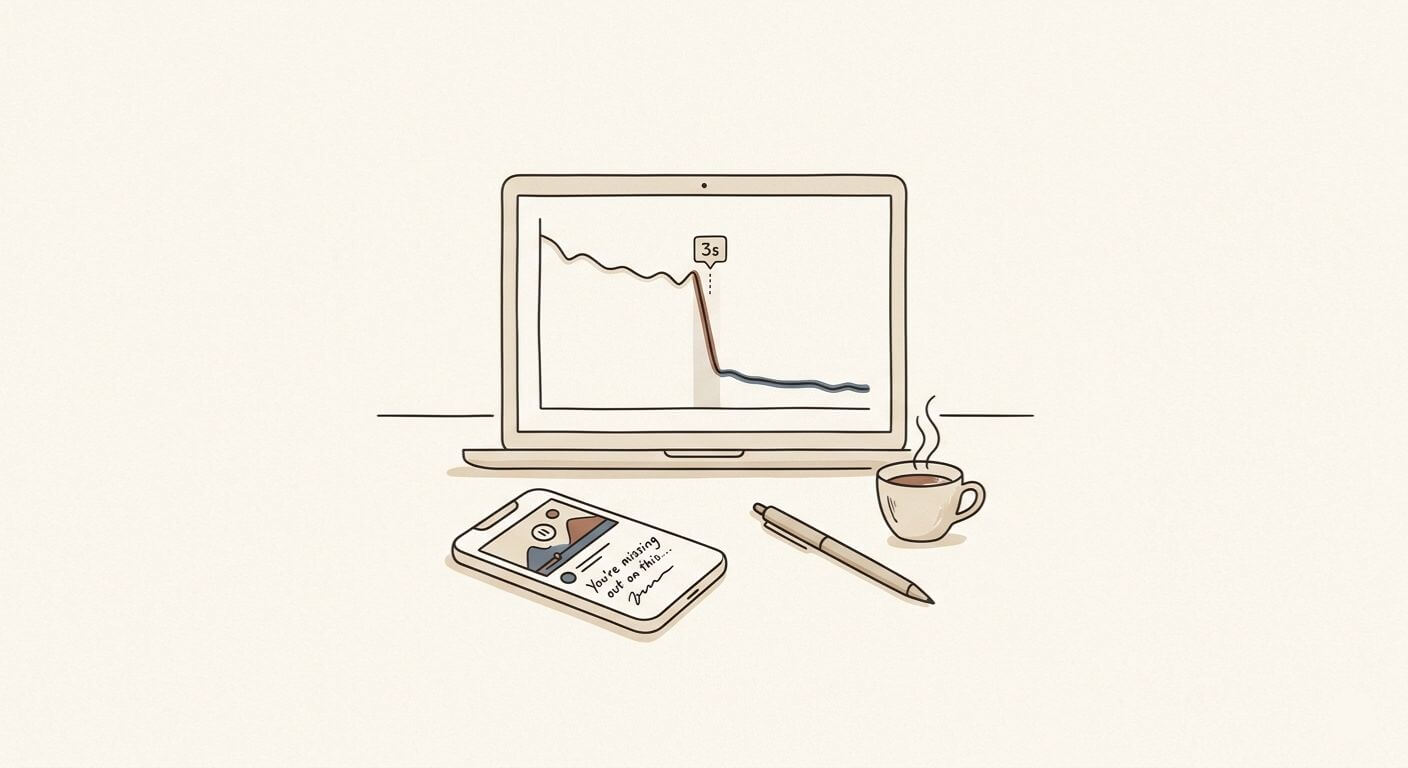
Short-form video has been overfit to a single emotional shortcut, FOMO.
FOMO is often treated as the default among emotional triggers in short-form video. And the problem with it is that it works too predictably and too often without depth.
Once an emotional trigger is used formulaicly, users start picking on it feeling like a tactic. The viewer recognizes the shape before the substance and at that point, the hook is legible as marketing.
For SEO professionals, content strategists, growth marketers, technical writers, and others in digital, something like FOMO is important to consider when evaluating which emotional triggers in short-form video actually drive performance.

Performance is often credited to the opening line, but the opening line is only the surface layer of a larger behavioral system. Many videos that appear to “win with FOMO” are actually succeeding because they create curiosity, signal identity, or activate status anxiety.
FOMO gets the credit because it is visible, but the deeper trigger is often the real driver.
FOMO is not the dominant trigger. It is one trigger, and often an overused one. The strongest short-form content is usually built around the correct emotional mechanism for the viewer’s state and the outcome you actually want.
What Emotional Triggers in Short-Form Video Actually Do
An emotional trigger is not the emotion itself. It is the behavioral catalyst that moves a viewer from passive exposure to active continuation.
In short-form video, and more specifically across different emotional triggers in short-form video, triggers influence whether someone:
- stops scrolling
- keeps watching
- rewatches
- shares
- comments
- clicks
- converts.
The platform never “sees” FOMO. It sees the behaviors those emotions produce. Emotional triggers matter only insofar as they alter attention and action.
Field Test: Open your GA4 engagement report. Do your top pages actually hold attention (avg. engagement time) or just attract clicks?
The obsession with “strong hooks” can be misleading. A hook is strong when it creates the right kind of unresolved tension. Some triggers create tension through missing information, others create it through social consequence. FOMO is only one way to create tension, and often, as I will argue, not the best one.
Why FOMO Became the Default
FOMO became popular for three reasons.
First, it is easy to manufacture. “Everyone is doing this,” and “Don’t make this mistake” are cheap to produce and easy to template. And they scale fast.
Second, FOMO is easy to recognize. It shows up in the first sentence, so marketers assume it is the driver of the result. It’s one of the most common attribution error where the visible trigger gets credit, even when another trigger is doing the heavier lifting.

Third, FOMO compresses decision time. It may be attractive in performance environments where output speed is rewarded more than emotional precision. But speed is not the same as effectiveness. A trigger that is easy to deploy is not necessarily a trigger that builds durable performance.
What People Commonly Misunderstand About FOMO
The biggest misunderstanding is that FOMO is a universal attention strategy.
FOMO works best when the viewer already has some level of intent. If the viewer is already considering a decision or already concerned about being left behind, then FOMO can accelerate action. In that context, it functions as a compression mechanism.
But when intent is absent, FOMO is often too shallow. It may create a view, but not a conversion; one reason high views don’t convert in otherwise well-performing content.
Field Test: In Google Search Console, look at queries bringing traffic. Do they signal intent (e.g., “best,” “how to”) or just curiosity?
FOMO, Curiosity, Identity, and Status Anxiety Are Not the Same Thing
These triggers are often lumped together because they can all improve performance. But they do so in different ways.
If this is speaking to you, I’ll send the next one when it’s ready.
FOMO: Action Compression
FOMO works by implying that delay has a cost. The viewer feels that skipping or waiting may result in loss.
It’s useful when:
- the audience already wants the outcome
- the window really is limited
- the action is simple

Examples include:
- limited-time offers
- trend-based opportunities
- time-sensitive alerts
- new feature rollouts
- competitor movement
- seasonal shifts
FOMO is weak when:
- the audience does not yet care
- the claim feels manufactured
- the offer requires trust
- the content is repetitive
- the “loss” is vague or exaggerated
Curiosity: Attention Expansion
Curiosity works by withholding resolution. The viewer stays because the brain wants closure.
Especially effective when:
- the topic is novel
- the payoff is not obvious
- the viewer wants to understand something
- the content can unfold in stages
- there is a visible information gap
Curiosity is often stronger than FOMO for watch time because it sustains attention through incomplete resolution. It invites the viewer to complete a pattern.
Field Test: Review your last 3 intros. Do they create a specific information gap, or just general intrigue?
Examples include:
- “Why this video performed better than expected”
- “What changed after we removed one variable”
- “The retention curve told us something unexpected”
Curiosity underperforms when:
- the payoff is too delayed
- the setup is vague
- the open loop is never resolved
- the content delivers novelty without utility
Identity: Trust Accumulation
Identity works by signaling who the content is for and what kind of person benefits from it. The viewer continues because the content reflects how they see themselves, or how they want to be seen.
Identity is especially effective when:
- the viewer is already near the category
- the content validates a worldview
- the audience wants belonging or status
- the message reinforces a professional self-image
- the content offers social signaling value

Examples include:
- “If you write for a living, this is the mistake that ruins clarity,”
- “The best strategists do not chase engagement; they map behavior.”
Identity is powerful because it drives shares and saves. People pass along content that represents them. They share what signals judgment, taste, expertise, or belonging.
Identity underperforms when:
- the audience is too broad
- the claim feels performative
- the content flatters without substance.
Status Anxiety: Social Pressure
Status anxiety is close to FOMO, but not identical. FOMO is about losing access. Status anxiety is about losing position.
It works by threatening one’s standing, be it competence or inclusion.
This is potent in professional and creator ecosystems where people compare themselves constantly. But it must be handled carefully. Too much status pressure creates defensiveness, and too little creates indifference.
Field Test: In GA4, look at conversion paths. Are users dropping off after informational pages, suggesting resistance rather than action?
Examples include:
- “Your competitors are already optimizing this”
- “This is why your content feels behind”
- “Most teams think they are ahead, but their retention says otherwise”
Status anxiety can drive action when the audience is ego-invested. It can also create resistance if the content feels accusatory or manipulative.
Why FOMO Is Overvalued
FOMO is overassigned.
Teams often see a video outperform, notice that the opening line sounded urgent, and conclude that urgency was the reason. But that is frequently an incomplete diagnosis. The real trigger may have been one of the following:
- curiosity created by an unresolved claim
- identity signaling that made the content shareable
- status anxiety that made the viewer compare themselves
- clarity that reduced cognitive friction
- or even a strong structural pattern unrelated to emotion.
FOMO is often visible in the copy. Curiosity and identity are often embedded in the structure, and it’s actually a reason why short form video hooks are not converting even when they appear strong. FOMO easier to credit, even when it is not the dominant mechanism.

There is also a second reason FOMO is overvalued: it is the easiest trigger to industrialize. AI-generated scripts, template-driven hooks (“10x your CTR” content factories) all gravitate toward urgency because it is simple to replicate. But scale exposes sameness. Once the audience recognizes the pattern, the trigger loses force.
When FOMO Underperforms and Short Form Videos Lose Retention Early
FOMO underperforms when the viewer needs more than urgency to continue.
1. When Intent Is Not Yet Present
If the audience has not entered the category, FOMO feels premature, and this is often where short form videos lose retention despite strong openings. They do not yet fear missing out on what they do not understand.
In that case, curiosity does the heavy lifting. It creates the desire to learn before FOMO can create the desire to act.
2. When Trust Matters More Than Speed
FOMO can accelerate clicks, but it can also make the message feel transactional. It’s a problem when the audience needs confidence or credibility.
It’s significant in:
- technical education
- B2B content
- product-led growth
- premium offers
- anything with high perceived risk.
Field Test: Add one credibility element (data point or internal link to proof) near the top. Track its impact on scroll depth.
3. When the Claim Is Familiar
FOMO depends on freshness. Once the pattern is expected, the brain moves faster as the viewer experiences recognition.
When every video says:
- “You are missing this”
- “Do this before everyone else”
- “Most people do not know this”
the message starts feeling like format.
4. When the Goal Is Retention or Rewatches
FOMO can spike early retention, but it rarely creates loops, which is why short form videos lose retention after the initial hook. Curiosity is often better for replays because the viewer is trying to complete unresolved information.
If your goal is distribution over time, not just first-3-second hold, FOMO is frequently the wrong default.
5. When the Audience Is Sophisticated

The more experienced the viewer, the faster they detect manipulation. For expert audiences, shallow urgency is often a signal that the content lacks substance.
The Behavioral Fingerprint of Each Trigger
If emotions are upstream and behaviors are downstream, then the question is: what behavioral fingerprints do different triggers leave?
Curiosity tends to produce watch time
Curiosity creates an information gap. The viewer continues because the answer is incomplete.
Valuable when your goal is:
- longer average view duration
- completion rate
- sequencing across multiple frames
It is especially effective in content that unfolds logically:
- “What happened next”
- “Why the obvious answer was wrong”
- “What the retention curve revealed”
Field Test: Add a mid-article “what happened next” subhead to one post. Track whether users continue deeper into the page.
Identity tends to produce shares
Identity works through self-expression. People share content that says something about them.
They share:
- because it validates a position
- because it aligns with their profession
- because it helps them look sharp
Identity-based content often spreads even when it is not the most urgent simply because it is socially useful.
FOMO tends to produce early retention
FOMO is strongest at the start. It can stop the scroll and force attention forward, especially when the viewer already values the thing being threatened.
But it often fails to sustain momentum unless another trigger takes over later. Without reinforcement, the viewer exits once the promise tension feels thin.
Status anxiety can drive action, but not always trust

Status anxiety can make people pay attention because no one wants to fall behind. Yet if the content feels shaming or exaggerated, it can backfire.
This trigger is high-risk, high-reward. It can motivate, but it can also reduce credibility.
How to Choose the Right Trigger
Use FOMO when the risk is missing a real opportunity
Use it when timing matters and the audience already cares.
Good fits:
- limited-time opportunities
- market shifts
- changing conditions
- trend windows
- policy or platform changes
Two rules:
- make the loss concrete
- pair urgency with proof
Field Test: Scan your copy. Does urgency stand alone, or is it supported by something that builds credibility?
Use curiosity when the risk is time
If the viewer is risking a few seconds, curiosity is the better trade. They stay because the answer is worth the attention cost.
Two more rules:
- open with an information gap
- resolve the gap in a way that deepens the premise rather than merely closing it
Use identity when the risk is self-perception
If the viewer is deciding whether this content is for someone like them, identity is the best lever.
Two rules here as well:
- speak to a specific worldview or working identity
- make the content feel like recognition
Use status anxiety when the risk is falling behind peers

This is effective in competitive markets, but it must be specific and credible.
Two rules for this one:
- tie the status threat to observable behavior
- avoid vague superiority language that sounds like social media theater
How to Reverse-Engineer Triggers from Retention Curves
Read the curve as an emotional sequence
A spike at the start means the opening created a credible promise. A drop after that often means the content did not pay it off.
Common patterns include:
- Early spike, then collapse: strong opening, weak reinforcement. The trigger was attractive, but the body of the video did not sustain tension.
- Flat, low retention: emotional neutrality. The content may be correct, but it does not compel.
- Repeated dips at specific moments: a promise was made and then broken, or the narrative lost relevance.
Field Test: Scan one article. Does each section clearly deliver on the expectation set before it, or drift off-topic?
Ask what emotional premise was created
Every high-performing video makes a promise, even implicitly. That promise might be:
- “This will save you time”
- “This will expose something you missed”
- “This will explain an unexpected pattern.”
Then ask whether the rest of the video actually delivers on that promise.
Look for evolution
Static emotion decays. If the video starts with urgency and keeps only urgency, the audience adapts. The message is too predictable.

The strongest videos often shift emotional mode as they move:
- curiosity opens the loop
- identity deepens relevance
- proof stabilizes trust
What to Do Instead of Defaulting to FOMO
1. Start with the viewer’s state
Do not begin with “What do I want them to do?” Begin with “What state are they in when they encounter this?”
Are they:
- unaware?
- mildly interested?
- already intentful?
- skeptical?
- identity-sensitive?
- comparing themselves to others?
That answer determines the trigger.
A growth team trying to push conversions may need FOMO, but a strategist trying to build trust may need identity.
Field Test: In GA4, segment a key page by new vs. returning users. Are you speaking to their actual level of awareness or intent?
2. Match the trigger to the outcome
Use the right trigger for the right result:
- FOMO → action compression
- Curiosity → attention expansion
- Identity → trust accumulation
Stop using urgency for everything.
If the actual goal is depth or shareability, FOMO is often the wrong lever.
3. Design for delayed impact
The best content does not always peak immediately. Some of the strongest videos begin with a narrow signal and expand into a more meaningful payoff.

The early frame should not try to do everything. It should create a reason to continue, then let the value compound.
Some ways to do this:
- open with a specific tension
- let the middle add proof or recontextualization
- reserve the clearest insight for later in the sequence
4. Use specificity instead of intensity
A line like “You are missing out” is intense, but not always specific. A line like “This is for teams whose retention falls after the first curve break” is less dramatic but far more targeted.
Specificity often outperforms intensity because it signals competence. It tells the right person, “this is for you,” without needing to shout.
5. Build trigger stacks
The most effective videos sequence emotional moments.
An example might look like this:
- curiosity opens the gap,
- identity identifies the audience,
- proof creates trust,
- FOMO compresses action at the end.
Much stronger than forcing FOMO into the first sentence and hoping the rest follows.
Field Test: Reorder one article to follow a sequence (curiosity → identity → proof → action). Monitor changes in time-on-page or conversions.
How AI Changed the Trigger Landscape
AI did made emotional triggers cheaper and more repetitive.
And it has two consequences.
First, audiences now recognize formulas more quickly. The emotional setup is easier to spot, so it loses some persuasive power before it can work.
Second, systems that rely on distribution signals are more and more sensitive to sameness. Similar content patterns compete with each other, and the most legible one is not always the most selected one.

Repetition reduces differentiation
When everyone uses the same trigger syntax, the signal turns into background noise. The audience no longer experiences the message as a meaningful prompt.
Distinctiveness turns into a distribution advantage
In crowded feeds, distinct content is easier to select and more likely to stand out against repetitive emotional templates.
That does not mean becoming weird for its own sake. It means using emotional cues with enough precision that the audience feels recognition instead of pattern fatigue.
Field Test: Scan your feed or site titles. Do they feel interchangeable with competitors, or immediately signal a recognizable point of view?
Stop Treating FOMO Like a Universal Answer
FOMO still works. It is just not the only trigger, and often not the best one.
The real problem is overvaluing it as the default explanation for performance. Many videos succeed because they trigger curiosity, reinforce identity, or activate status sensitivity. FOMO gets the credit because it is the easiest mechanism to see.
In short-form video, the strongest emotional trigger is the one that matches the viewer’s state and survives beyond the first sentence. Curiosity expands attention. Identity accumulates trust. Status anxiety can drive comparison. FOMO compresses action. Each has a job. None should be treated as universal.

Rox Jibotean
Writer & Editor, Beyond Chit-Chat
I write about the space between what the digital shows us and what people are actually experiencing, and how things begin to reveal themselves when you learn to see both at once.
@rox.jibotean on IG →