
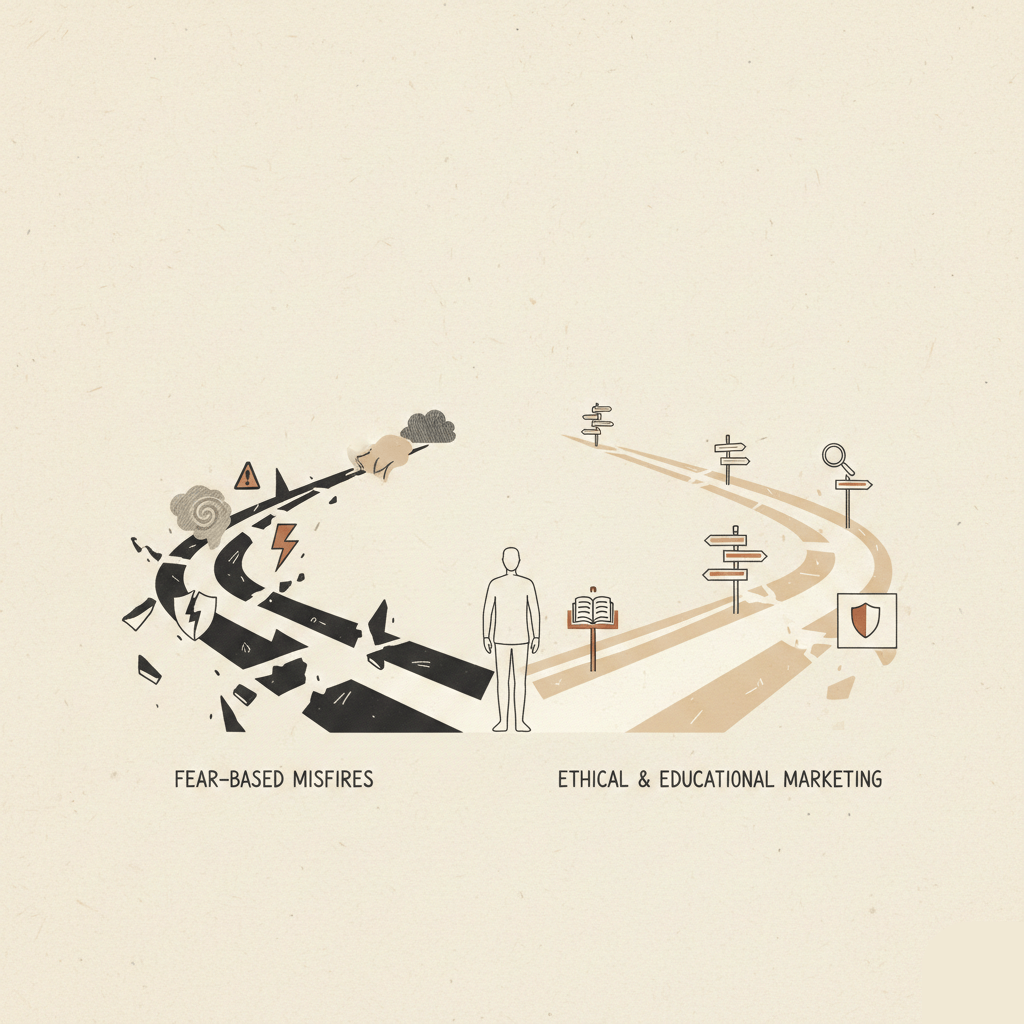
Fear can be an effective motivator in marketing, but fear-based marketing is not a blunt instrument. Treat it like you would any other hypothesis in any other intervention: testable, measurable, and bounded by ethics and brand risk.
When threat and solution credibility align, action follows. When they don’t, fear produces avoidance and long-term brand distrust.

We’ll get into what’s going on behind fear-based appeals, show how to build and test them as rigorous experiments, and give a compact playbook for safer, high-return alternatives to fear-based marketing.
Why Fear-based Marketing Drives Action (and Risks)
At its core, fear-based marketing deliberately raises a perceived threat and pairs (or fails to pair) that threat with a proposed mitigation, be it a product, behavior, or service.
Two variables determine whether an appeal produces action or recoil:
- Perceived threat intensity – How serious and how likely the audience believes the danger to be.
- Perceived efficacy – How credible and clearly achievable the proposed mitigation feels.

The hypothesis is:
high threat + high efficacy → action
high threat + low efficacy → avoidance or denial
This is your guiding testable model. It maps directly onto established psychological theories you can rely on when designing campaigns:
- Extended Parallel Process Model (EPPM): Action occurs only when threat and efficacy are both high, otherwise people avoid or deny.
- Protection Motivation Theory: Behavioral intention = threat appraisal × coping appraisal. Both sides matter.
- Prospect Theory / Loss Aversion: People weigh losses more than gains, so framing as avoiding loss can be persuasive.
Psychological Mechanisms of Fear-based Marketing that Convert
Fear-based marketing campaigns work through distinct psychological levers. Notice the mechanism and the risk for each application:
Health & safety: Highlight personal vulnerability + severe consequence → preventive action.
Risk: exaggeration spurs mistrust or panic.
Example: Home-security ad showing a break-in. If the scenario is unlikely or dramatized, you burn credibility.
Appearance / identity: Trigger social-evaluation anxiety and loss-framing → purchases to restore identity.
Risk: harms self-esteem and invites regulation or negative press.
Example: Anti-aging copy that implies social ostracism for aging.

Financial security / insurance: Use salient worst-case scenarios to emphasize loss avoidance. Risk: overselling improbable disasters erodes trust.
Example: “You could lose everything” without clear, realistic framing.
Across all areas, fear-based marketing requires precision and restraint to avoid predictable psychological and reputational fallout.
Every mechanism that heightens threat must also increase the salience of an effective, believable relief. Otherwise, you create anxiety with no exit, which triggers avoidance, complaints, churn.
Testable Fear-based Marketing Steps
1) Diagnose audience fears for fear-based marketing tests
- Map audience anxieties (health, finance, safety, social image). Use surveys, support logs, search queries, and social listening.
- Verify base rates – how real is the risk? (Don’t guess, get data.)
- Segment: different audiences respond to different triggers; homeowners vs renters, young parents vs empty-nesters.

2) Design threat + solution pairs for responsible fear ads
- Write an emotionally salient threat that is proportional to real risk.
- Pair it with a clear, verifiable solution: what the user should do, why it works, how fast, and how much it costs.
- Channel plan: choose ads, email, landing pages, social placements that let you control context and provide aftercare (support/hotline/refund info).
Fear without visible efficacy drives avoidance and reputational harm.
3) Pretest creatives: measure threat, efficacy, trust, anxiety
- Run a perceptual pretest (n ≈ 200) to measure perceived threat, perceived efficacy, anxiety, and trust for each creative variant.
- Drop variants that create threat without increasing efficacy since those are red flags.

4) RCT rollout to validate fear-based marketing hypotheses
Design an A/B/RCT with four arms to validate the EPPM-informed hypothesis:
- Arm A (Control): Neutral/no threat + high-efficacy product benefits → baseline.
- Arm B: Low threat + high efficacy → modest concern, modest uplift.
- Arm C: High threat + high efficacy → predicted maximum action.
- Arm D: High threat + low efficacy → predicted defensive reactions and avoidance.
Primary behavioral metrics: CTR → add-to-cart → purchase → LTV.
Psychometric metrics: perceived threat, perceived efficacy, anxiety, trust, intention.
Brand metrics: retention, NPS, refund rate, complaint volume, social sentiment.
Predefine pause rules (see Measurement & Safety Thresholds below) before you launch.
5) Measure conversions and brand harm after fear ads
- Track short-term conversion lift and immediate psychometrics.
- Track mid- to long-term brand health at 30/60/90 days (churn, refunds, complaints, sentiment).
- If threat rises but efficacy perception falls or brand harm exceeds thresholds, pause and pivot.

Safety Thresholds & Metrics for Fear-based Marketing Tests
Turn ethics into concrete signals, especially when evaluating fear-based marketing:
Conversion lift: compare against control; expect C > B > A if theory holds.
Short-term harm signal: complaints per 10k impressions – set a conservative threshold (for example, pause if complaints exceed 5× baseline).
Brand health: churn differential and NPS shifts at 30/60/90 days vs control.
Psychological mismatch: watch for the pattern Threat ↑ and Efficacy ↓ – that’s the unsustainable signature of a harmful fear-based marketing message.

Make these thresholds explicit in your experiment plan. Predefine KPIs that will force a pause and remediation. Do not leave this to judgment calls mid-flight.
Govern Fear-based Advertisements Safely
Treat responsibility as a part of performance:
Minimum ethical principles for fear-based marketing use
- Truthfulness: Do not exaggerate probability or severity.
- Proportionality: Match intensity of message to real-world risk.
- Efficacy: Always include a credible, verifiable mitigation. Provide evidence (studies, third-party backing, testimonials with provenance).
- Non-exploitation: Avoid targeting acutely vulnerable populations.
- Aftercare: Provide support resources (hotline, clear refund policy, terms).
- Monitoring: Predefine KPIs for complaints, opt-outs, and negative sentiment; stop if exceeded.
Red flags: when to stop fear-based advertising immediately
- Low-probability-but-emotionally-charged scenarios without evidence.
- Targeting people currently in acute distress (disaster victims, bereaved).
- Messaging when product efficacy is uncertain or unproven.
- Brand lacks infrastructure to deliver promised mitigation (no refunds, no support, no verification).
Safer alternatives that preserve effectiveness
If your goal is behavior change with lower brand risk, favor empowerment and social proof frames that harness the same motivational levers without excessive fear.
- Empowerment framing: emphasize control and simple steps.
Example: “Protect your family with three easy steps.” - Social proof / normative framing: show peers benefiting.
Example: “Join 1,000+ homeowners who reduced incidents.” - Urgency without existential threat: scarcity or time-limited offers that create action without existential fear.
Example: “Limited spots today – secure your inspection.”
Copy swap examples: fear vs ethical fear-based alternatives

- Fear: “If you don’t install this system, your home will be broken into.”
Ethical alternative: “9/10 customers report fewer security incidents – try our 30-day free trial.” - Fear: “Stop wrinkles now or you’ll look 10 years older.”
Ethical alternative: “Clinically shown to reduce fine lines in 4 weeks – dermatologist-backed starter kit.” - Fear: “You can lose everything without insurance.”
Ethical alternative: “Protect your savings against unexpected events – compare coverages, no-obligation.”
These alternatives maintain urgency and loss-avoidance framing (prospect theory) while reducing existential pressure and preserving trust.
Quick Checklist for Fear-based Marketing tests
- Define target fear – verify base rate and relevance.
- Assess efficacy – evidence/timelines/testimonials/trials; can you prove it?
- Draft two creatives – (A) high-efficacy fear; (B) empowerment alternative.
- Pretest (n≈200) – capture perceived threat, efficacy, trust, anxiety.
- Run RCT (4 arms) – measure behavior + psychometrics + brand outcomes.
- Predefine pause rules – complaints, opt-outs, sentiment thresholds.
- Measure immediate + 90-day outcomes – conversion lift and churn/NPS.
- Archive results & compliance evidence – creative, pretest data, RCT outcomes, remediation actions.
Use fear deliberately and treat it as a diagnostic tool to see whether the product and the brand can credibly offer relief. The safest, most durable wins come from designs that raise a real problem while immediately demonstrating a believable path out, backed by evidence, tested empirically, and governed by explicit ethical thresholds.

When you follow this approach, you get the motivating power of loss aversion and urgency without the corrosive side effects that make fear-based marketing toxic in the long run.
Fear-based Marketing on Social Media
If fear in marketing is already a volatile tool, social media hooks function as an accelerant. The architecture of these platforms – precision targeting, emotionally charged visuals, frictionless sharing – turns ordinary fear appeals into high-velocity emotional contagion.
What begins as a controlled marketing tactic can quickly become an uncontrolled social dynamic. Understanding this amplification effect is essential for any practitioner who wants to drive action without degrading trust or harming audiences.
Why Social Platforms Amplify Fear-based Advertisements Fast
Fear thrives on social media because the platforms are engineered to privilege emotional salience.
Micro-segmentation allows marketers to identify and reach audiences whose psychographic profiles are more sensitive to particular threats like parents concerned about safety or young professionals anxious about finances.
That precision meets a second accelerator: visual immediacy. Humans process emotionally charged images and short-form videos far faster than rational argument. A threatening visual, a damaged home or a suspicious stranger, arrests attention in a way text alone rarely can. Fear-based campaigns leverage motion, close-ups, and narrative snippets to create scroll-stopping moments that spike arousal instantly.

A third amplifier is the shareability of fear. People often share fear-inducing content as a form of social signaling (“I’m warning you”) or altruism (“Be aware”). That sharing, however, often strips away nuance: once the content escapes the original ad container, ethical safeguards weaken. A fear appeal originally designed with context and mitigation may reappear as a screenshot severed from its solution, a risk that grows with virality.
The result is that social media strengthens susceptibility and accelerates diffusion, increasing both the effectiveness and the potential harm of fear-based messaging.
Fear-based ads on Facebook, IG, Twitter
Fear-based appeals adapt to each platform’s cognitive constraints and content rhythms.
On Facebook, carousel ads support sequential storytelling, a small narrative arc that heightens threat and then introduces relief. Long-form complementary content (blogs, testimonials, infographics) gives users the efficacy cues needed to reduce defensive avoidance, making CTAs like “learn more” or “get covered” feel reasonable rather than manipulative.
Instagram leverages the ephemerality of Stories and the intimacy of polls and quizzes. Interactivity deepens emotional engagement; a question like “Would you know what to do in an emergency?” positions the user inside the threat scenario. Swipe-up CTAs link directly to deeper resources or scheduling flows, but the platform demands visual coherence to avoid the impression of melodrama.

On Twitter, brevity rules. A short fear cue paired with an image or video clip provides the initial cognitive anchor. Scarcity cues often outperform heavier existential threats here because the platform’s tempo rewards speed, not immersion. CTAs typically push to guides or consultations where efficacy can be established in fuller form.
YouTube, by contrast, supports long-form narrative. 10–15 minute videos allow dramatization, identification, and social proof from influencers. But the length also creates a responsibility. The longer the exposure to threat, the more important it becomes to introduce efficacy throughout the narrative, not only at the end.
Across all platforms, complementary content establishes efficacy and prevents defensive avoidance (per EPPM) and CTAs translate threat perception into a specific, reasonable behavior rather than ambient anxiety.
How Fear-based Marketing Erodes Trust
Fear-based marketing produces quick bursts of attention, but attention is not the same as affinity. Over time, repeated exposure to threat-oriented content weakens the emotional bond between brand and audience.
The first degradation is a weakening of relational trust. When a brand optimizes for immediate action, it often sacrifices the signals of care and authenticity that sustain loyalty. Audiences begin to see the brand as an opportunist rather than an ally.
Next comes negative conditioning. If a user repeatedly encounters fear next to your logo, the emotional association becomes entrenched. Even neutral messages later can trigger residual anxiety or aversion.

Fear also struggles with sustained interest. It spikes arousal, but arousal fades quickly, and fear-coded content has low brand stickiness. Without a compelling relief message or empowering narrative, the mind classifies the content as noise or as something to avoid.
Finally, there is identity rupture. If fear-based marketing drifts too far from the brand’s established values, audiences experience cognitive dissonance: “This doesn’t feel like them.” Once authenticity fractures, trust decay spreads across every future communication.
Fear-based social campaigns, therefore, often represent short-term optimization at the expense of long-term equity.
Backlash from Repeated Fear-based Ads
With social media’s frequency and repetition, fear appeals encounter a predictable set of behavioral patterns.
- Habituation dulls sensitivity. Once users get used to threat cues, the same message produces less response, prompting marketers to escalate intensity. That escalation is inherently unsustainable and raises ethical stakes.
- Desensitization and backlash follow. Users skip ads, block brands, and report content they perceive as manipulative or overly dramatic.
- Trust decay is the most pernicious dynamic. If audiences sense exaggeration or intent to manipulate, the skepticism generalizes. They distrust not just the fear message but the entire brand’s communications.

The paradox is that the more shareable the fear content is, the more it spreads, and the harsher these long-term dynamics become. High virality amplifies both engagement and erosion.
Responsible Social Media System for Fear-based Campaigns
The responsible use of fear on social platforms requires an operational model that accounts for platform dynamics, efficacy signaling, relational metrics, and ethical constraints.
1. Map threat to platform
Select formats that match the cognitive style of the platform. Anxiety-heavy narratives belong in longer-form spaces (YouTube), while lighter, low-intensity prompts perform better where attention is brief (Twitter, Stories).

2. Surround fear with efficacy
Social media demands immediate reassurance. Every threat cue should be quickly followed by a credible, actionable solution: tutorials, testimonials, data-backed claims, or clear next steps.
3. Monitor relationship signals, not just conversions
Track sentiment, complaints, opt-out behaviors, share patterns, and retention alongside CTR and ROAS. If relational metrics dip while conversions rise, you’re burning brand capital.
4. Balance short-term ROI with long-term loyalty
In quarterly dashboards, evaluate not only conversion lift but trust indicators like NPS movement and repeat purchase rates. Fear-based wins are often offset by six-month declines unless mitigated.
5. Ethical guardrails for social environments
- Anchor every threat in real probability and severity.
- Use authentic testimonials instead of dramatization.
- Avoid targeting populations in acute distress or low-agency states.
- Limit frequency and avoid escalation cycles that create habituation.
- Review viral risk: could your message circulate stripped of context or mitigation?

Why Fear-based Marketing Persists
To understand why fear-based marketing persists despite its ethical hazards and long-term brand costs, we must momentarily step inside the worldview of the content creator who builds these campaigns.
This is not an exercise in blame but in comprehension. When you understand the incentives, cognitive biases, and competitive pressures that shape creators’ decisions, you also understand why fear-based marketing is so tempting, and why escaping its gravity requires structural, not just moral, change.
Why Creators Default to Fear-based Advertisements Tactics
Most fear-based marketing does not come from malice. It comes from short-term metrics, competitive norms, and the psychological blind spots that affect even the most rational marketer.
Creators face relentless pressure to hit performance goals – clicks, sign-ups, purchases. Fear reliably spikes these metrics because perceived threat triggers urgency.
Competitive pressure deepens this dependence. When peers or competitors lean into fear tactics, creators worry that appearing “softer” will place them at a disadvantage.

Fear of falling behind becomes, ironically, a motivator for using fear. This creates a homogenization effect with everyone escalating intensity, not because it is the best strategy, but because no one wants to be the first to de-escalate.
At the cognitive level, creators rationalize these choices. Confirmation bias leads them to remember the fear-driven campaigns that worked while forgetting the backlash or brand damage.
Cognitive dissonance encourages reinterpretation: “I’m not manipulating, I’m helping them take action.”
This mindset is not villainous, but it is short-term, outcome-focused, and structurally reinforced. It also misses what matters most: the relational and reputational consequences that unfold over months and years.
Justifying Fear-based Marketing Choices
Even practitioners who pride themselves on data-driven rigor are vulnerable to predictable cognitive biases:
- Outcome bias: When a campaign delivers conversions, creators interpret the tactic as sound, even if the process was manipulative or the long-term impact was negative. Fear becomes “validated” by short-term numbers.
- Cognitive dissonance reduction: Creators want to see themselves as competent and ethical. When fear-based tactics clash with that identity, they reinterpret their intent (“The audience needs to hear this”) to preserve self-image.
- Social comparison heuristics: Creators assume competitors’ behavior defines the minimum survival threshold. If “everyone” is using fear, then fear becomes the assumed cost of staying competitive. Herd behavior follows, with escalating intensity.

Without conscious intervention, these biases anchor creators to a tactic that feels effective but slowly corrodes trust.
Ethical Alternative to Fear-based Ads
If fear is the shortest path to immediate action, educational marketing is the longest, but the most durable. Rather than manipulating anxiety, educational marketing builds authority, provides clarity, and empowers the audience with knowledge. It replaces threat with understanding.
Where fear-based marketing triggers immediate behavior through arousal, educational marketing motivates through comprehension. It is inherently relational since it signals that the brand is competent and aligned with the audience’s long-term interest.
The contrast is stark:
- Fear drives urgency, while education drives engagement.
- Fear messages burn out quickly; educational content has evergreen utility.
- Fear creates weak, transactional relationships; education builds authoritative, loyal ones.
Educational marketing also affords practical advantages. It leverages expertise (often underutilized inside organizations), adapts to diverse channels (blogs, videos, webinars, infographics) and fits naturally into a trust-building loop: useful content leads to repeated engagement, which produces authority, which increases loyalty and reduces acquisition cost.

It is slower, yes. But it is stable and aligned with long-term brand health.
How Creators Shift from Fear to Educational Marketing
Moving away from fear-based marketing requires more than deciding to “be ethical.” It requires a structured transition. That transition unfolds in five stages.
Step 1: Audit existing content
Identify where fear-based marketing currently appears, what triggers, what narratives, what tones. Evaluate severity and psychological impact.
Step 2: Map expertise to audience needs
Determine what your audience most needs to know. Inventory internal knowledge: research, processes, guides, insights. Translate that expertise into value.

Step 3: Reframe narratives into lessons
Shift from threat to guidance.
Instead of: “Protect your home from burglars or face loss.”
Reframe as: “Five proven ways to secure your home and protect your family.”
Fear becomes context for education, not the primary driver.
Step 4: Experiment and measure relational metrics
Run controlled tests comparing educational content against fear-based marketing baselines. Track trust, repeat visits, shares, dwell time, and soft CTAs (“download the guide”). Measure both short-term conversions and long-term loyalty indicators.
Step 5: Transition gradually
Do not shock the audience by abruptly removing urgency. Replace fear with urgency rooted in competence: deadlines, limited spots, or seasonal relevance; paired with clear, credible efficacy.
Why Educational Marketing Outperforms Fear-based Tactics Long-term
From a persuasion standpoint, fear and education operate differently.
- Fear-based persuasion uses high arousal to trigger behavior, but high arousal burns fast. Relationships weaken, ethical risk grows, and brand equity erodes.
- Educational persuasion uses moderate arousal and cognitive engagement. It creates deeper processing, produces more stable actions over time, and builds lasting relational bonds.
- Hybrid persuasion blends urgency with expertise. It balances short-term conversion with long-term trust, offering a productive middle path for brands transitioning away from pure fear appeals.
Education transforms persuasion from threat management into competence signaling. People act not because they fear outcomes, but because they trust the brand that teaches them how to avoid those outcomes.

Educational Marketing as a Scalable Alternative
1. Rethink fear vs education: build measurable learning funnels
Fear-based marketing follows a simple behavioral arc: scare → react → convert.
Educational marketing is often dismissed as slower or less direct, but this is only true when it’s unstructured. When systematized, educational content becomes precise and performance-driven.
A systematized educational engine includes:
- Modular, measurable content blocks (blogs, webinars, calculators, tools)
- Clear tagging and tracking linked to audience actions
- Defined learning pathways from understanding → evaluation → decision → action
2. Education vs manipulation in marketing copy
The ethical distinction between education and manipulation lies in how the audience is framed.
| Feature | Education | Manipulation |
| Tone | Invites curiosity, provides clarity | Accusatory, anxiety-inducing |
| Agency | Reader is an informed decision-maker | Reader is a pressured pawn |
| Messaging | “Here’s how to evaluate your options.” | “Act now or suffer consequences.” |
| Outcome | Trust, longevity, repeat engagement | Fast conversions with relational decay |
As a rule of thumb, respect the audience’s cognitive ability. Cross that line and you’re not teaching, you’re cornering.
3. Use emotion constructively in educational marketing, not fear
Emotion isn’t the enemy. Misused emotion is. When paired with context and actionable guidance, emotion fuels clarity and motivation.
| Emotional Lever | Constructive Use | Harmful Use |
| Fear | Highlight a real risk + provide a roadmap | Alarm with no path forward |
| Urgency | Real deadlines, regulatory shifts | Faux scarcity, artificial pressure |
| Empathy | Validate needs and concerns | Exploit pain points |
Be a guide, not a trickster. Emotion paired with a roadmap transforms fear into agency, and urgency into momentum.
4. AI for educational marketing: scale precise, ethical content
AI transforms educational marketing from “craft” to scalable system by enhancing precision and measurability, an especially important shift for brands moving away from fear-based marketing toward more constructive communication.
| Capability | Application |
| Content Ideation & Validation | Analyze search intent, competitor gaps, audience sentiment |
| Segmentation & Personalization | Cluster users by behavior or needs; tailor content journeys |
| Automated Modularization | Break long-form content into platform-specific micro-assets |
| Performance Forecasting | Attribute content to learning progress, engagement, and conversion |
Risk Management With AI
- Favor experimentation over perfection. Not every “hero” asset wins.
- Lean on data over instinct. Log AI rationales and evaluate them.
- Be transparent. Avoid overpromising; consistency builds trust.
5. Systematize content funnels to replace fear-based paths
A modern educational marketing engine follows a clear, repeatable sequence:
- Audience Understanding
Segment by fears, goals, motivations, and learning gaps. - Content Design
Replace anxiety-driven framing with actionable, credible, modular education. - Platform Adaptation
Tailor format, pacing, and interactivity (carousel vs. story vs. long-form video). - Emotion Integration
Use empathy and genuine urgency to help, not push, your audience. - AI Optimization
Use AI for ideation, personalization, modularization, and attribution modeling. - Measurement
Track both:
- Short-term: clicks, conversions, behavioral triggers
- Long-term: trust, retention, loyalty, advocacy
- Short-term: clicks, conversions, behavioral triggers
- Ethical Guardrails
Prioritize transparency, proportionality, and audience respect. - Iterate & Evolve
Continuous testing + qualitative feedback → compounding improvement.
6. Behavioral mechanics behind fear vs education
| Concept | Fear-Based Marketing | Education-Based Marketing |
| Behavioral Driver | Threat-induced arousal → reactive behavior | Cognitive engagement + empowerment → sustained action |
| ROI Horizon | Immediate, short-term conversion | Long-term behavioral and relational value |
| Scalability | Fast, emotional, volatile | Modular, trackable, AI-optimized |
| Ethical Risk | High (manipulative, trust-eroding) | Low (transparent, empowering) |
| Audience Relationship | Transactional, fragile | Authoritative, loyal, durable |
Educate → Empower → Act, not Scare → Act
Replace the reflexive pipeline of fear-based marketing:
“Scare → Act”
with the modern, ethical, and scalable pathway:
“Educate → Empower → Act.”
In this way, you protect both behavioral effectiveness and relational equity, closing the loop between performance, ethics, and long-term brand trust while reducing reliance on fear-based marketing.